
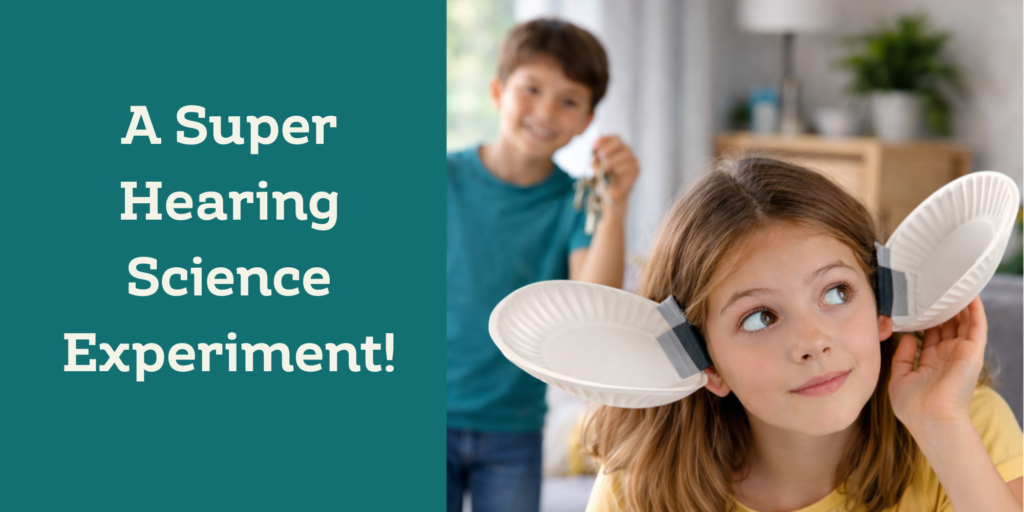
Ever wondered how animals like bats, foxes, or owls can hear tiny sounds and quickly figure out where they’re coming from? Their secret isn’t just sharp hearing — it’s also the shape of their ears.
In this experiment, you’ll build a pair of giant “bat ears” to explore how ear shape can change the way we hear sounds. Then you’ll test them like a scientist to see whether they help you track where a sound is coming from.
This activity is part engineering, part physics, and part detective work — exactly the kind of science we love.
What You’ll Need
- 2 large paper plates (or small paper bowls)
- A headband, hat, or strip of sturdy cardboard
- Tape or glue
- Scissors
- Optional: markers or stickers to decorate your ears
How to Build Your Bat Ears
- Take each paper plate and gently curve it so it forms a shallow dish shape. The curved surface will help reflect sound waves.
- Tape or glue each plate to the sides of your headband so they stick out like large animal ears.
- Position the plates slightly behind your ears, not directly on top of them. This helps the curved surface reflect some sound waves toward your ear.
- Angle the plates slightly forward, like listening dishes.
- Put on your new “bat ears” and get ready to test your super hearing.
Tip: Quiet sounds work best for this experiment.
Science Challenge: Can You Find the Sound?
Now it’s time to test how well your bat ears work.
Ask a partner to stand somewhere in the room and make a quiet sound such as:
- snapping their fingers
- tapping a pencil
- whispering
- crinkling paper
- jingling keys
Close your eyes and slowly turn your head until you think you know where the sound is coming from. Point to the direction where you think the sound started.
Try It Three Ways
| Test | What to Try |
|---|---|
| Test 1 | Normal hearing |
| Test 2 | Wearing your Bat Ears |
| Test 3 | Covering one ear with your hand |
Which test helped you locate the sound most easily?
Real scientists learn by comparing results — and that’s exactly what you just did.
What’s Happening?
Sound travels through the air as vibrations called sound waves.
The curved plates of your bat ears can reflect some of those sound waves toward your ears. When the plate faces the sound source, more of that reflected sound may reach your ear, making the sound seem a little clearer.
Turning your head changes how sound waves reach your ears, which helps your brain figure out where the sound is coming from.
Animals like bats, foxes, and owls use large or specially shaped ears to help them detect even tiny noises.
Smart Girl Science Fact
Owls have one ear slightly higher than the other.
This clever design helps them detect sounds not just from left or right — but also from above and below.
That’s how owls can hunt small animals in complete darkness using sound alone.
The Learning Behind the Play
Directional hearing
The shape of ears can affect how sound waves reach them.
Binaural hearing
Humans use two ears to detect tiny differences in sound timing and loudness. Your brain compares those differences to help locate the source of a sound.
Animal adaptations
Animals with large or specially shaped ears can often hear very quiet sounds.
Take It Further
Try experimenting with different ear shapes:
- bigger plates
- deeper bowls
- cone-shaped ears made from paper
Which design helps you locate sounds the fastest?
What Kids Will Walk Away With
- A better understanding of how hearing works
- A hands-on experience with sound waves and directionality
- Curiosity about how animals sense the world
- A fun homemade gadget they’ll test around the house
Explore the Hey Smart Girl Science Series
Fun science books for curious girls aged 8–12. Big ideas are made easier through experiments, real-world examples, and hands-on discovery.

Book of Chemistry
Discover bubbling reactions, crystal experiments, and surprising science facts that bring chemistry to life.
See the Chemistry Book
Book of Physics
Discover gravity, motion, light, and sound through simple explanations, hands-on activities, and big ideas brought to life.
See the Physics Book
Book of Biology
From cells to body systems, this biology book helps girls connect science to everyday life in a clear and interesting way.
See the Biology Book





One Response