Nobody has ever been to the centre of the Earth. No drill has come close. No probe has reached it. The deepest hole ever dug by humans — the Kola Superdeep Borehole in Russia, drilled over decades — got about 12 kilometres down before the heat and pressure made it impossible to continue.
The Earth’s core is nearly 6,400 kilometres below our feet.
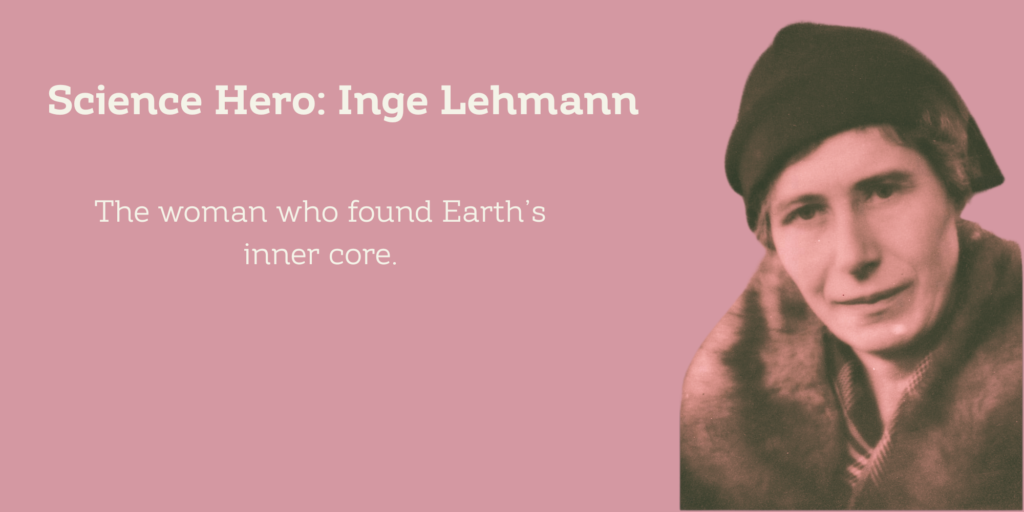
And yet in 1936, a Danish scientist named Inge Lehmann sat at a desk, studied a set of wavy lines on paper, and worked out exactly what was down there.
No expedition. No equipment beyond what she already had. Just careful observation, rigorous thinking, and the conviction to trust her evidence when almost nobody else did.
If you’re looking for a story to give a curious girl — one that shows exactly what a scientific mind can do — this is it.
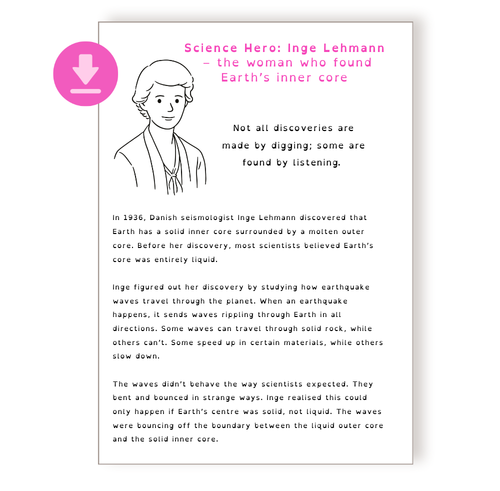
Want the printable story card?
Quick facts:
- Science hero: Inge Lehmann
- Field: Seismology
- Known for: Discovering that Earth has a solid inner core
- Why it matters: Her work helped scientists understand earthquakes and the structure of our planet
The story
Inge Lehmann was born in Copenhagen in 1888. From an early age she was fortunate in one specific way — her father believed in educating girls and boys equally, at a time when that was far from the norm. She attended a school where girls and boys were taught the same subjects, by the same teachers, to the same standard.
It shaped how she saw the world: not as somewhere that placed limits on what she could understand, but as somewhere full of questions worth answering.
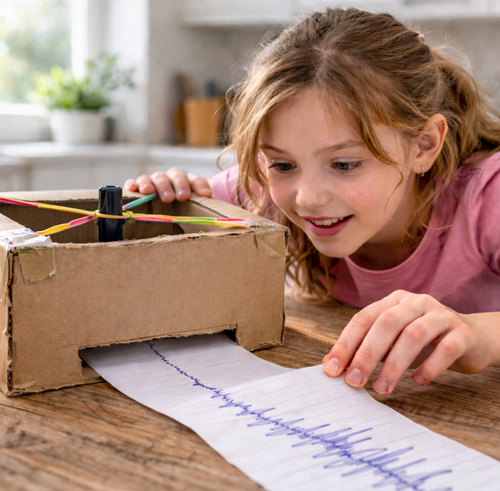
She went on to study mathematics and later seismology — the science of earthquakes — eventually becoming the head of the seismological department at the Geodetical Institute of Denmark. In the 1930s, her job involved analysing data from seismographs: instruments that recorded earthquake waves as inked lines on paper rolls. When the ground shook anywhere in the world, the waves rippled outward through the Earth and the seismographs picked them up.
The data kept showing something that didn’t make sense.
After large earthquakes, certain seismic waves were turning up in places they shouldn’t — at angles and distances that didn’t fit the accepted model of what the Earth’s interior looked like. The scientific consensus at the time was that the Earth had a liquid core all the way through. But if that were true, the waves should have behaved differently.
They weren’t behaving differently.
They were doing something else entirely.
Inge spent years gathering data, ruling out other explanations, and building her case. In 1936 she published a paper — its entire title just the letter P’ — proposing that the Earth does not have a single liquid core, but two: a liquid outer core surrounding a solid inner core. The waves were bouncing off the boundary between them. That boundary is why they appeared where the existing model said they shouldn’t.
Many scientists were sceptical. The idea contradicted what had been assumed. But the data was the data. Over the following years, as more evidence accumulated, the scientific community came around — not because Inge had argued louder, but because she had been right.
The boundary between the Earth’s inner and outer core is now named the Lehmann Discontinuity. It will carry her name for as long as geoscience exists.
She worked as a seismologist until she was 75. She lived to be 104. She never stopped being curious about how the Earth works.
The science — what did she actually figure out?
When an earthquake happens, it sends seismic waves rippling outward through the Earth in every direction — through rock, through liquid, through whatever is down there. Different types of waves behave differently in different materials. Some can only travel through solid rock. Others can move through liquid. Some speed up, some slow down, some bend, and some bounce.
By studying where waves ended up after passing through the Earth — which stations picked them up, at what strength, and at what angle — seismologists can reverse-engineer what the waves must have passed through to get there.
It’s a bit like working out the shape of a room you’ve never seen by listening to how sound bounces around inside it.
What Inge noticed was that certain waves, called P-waves, were appearing in a shadow zone — a region on the far side of the Earth where, according to the liquid-core model, they shouldn’t have been detectable at all. The only explanation that fit the data was a solid inner core.
P-waves could travel through it, and were being refracted — bent — as they crossed the boundary between the liquid outer core and the solid centre, ending up exactly where she was detecting them.
She worked this out from lines on paper. Without ever leaving her desk.
Want to make this idea feel real?
Wondering what a seismograph actually is — and how it works? She can find out and build one herself right here on this blog. It takes about 20 minutes, uses things you already have at home, and produces a working instrument that records real movement on paper.
Why it matters today
Knowing the structure of the Earth’s interior isn’t just academically interesting — it has direct, practical consequences for people alive right now.
Understanding how seismic waves travel through the different layers of the Earth — solid inner core, liquid outer core, mantle, and crust — allows scientists to build much more accurate models of how earthquakes behave. Those models inform how engineers design buildings in earthquake-prone regions. They also underpin the early-warning systems that give people precious seconds of notice before shaking arrives.
In a major earthquake, seconds matter enormously.
Inge Lehmann’s discovery — made at a desk, from paper records, in 1936 — is embedded in the science that protects lives today. That’s what fundamental research does. It doesn’t always have an obvious immediate application. But it builds the foundation that everything else stands on.
What your daughter can take from this story
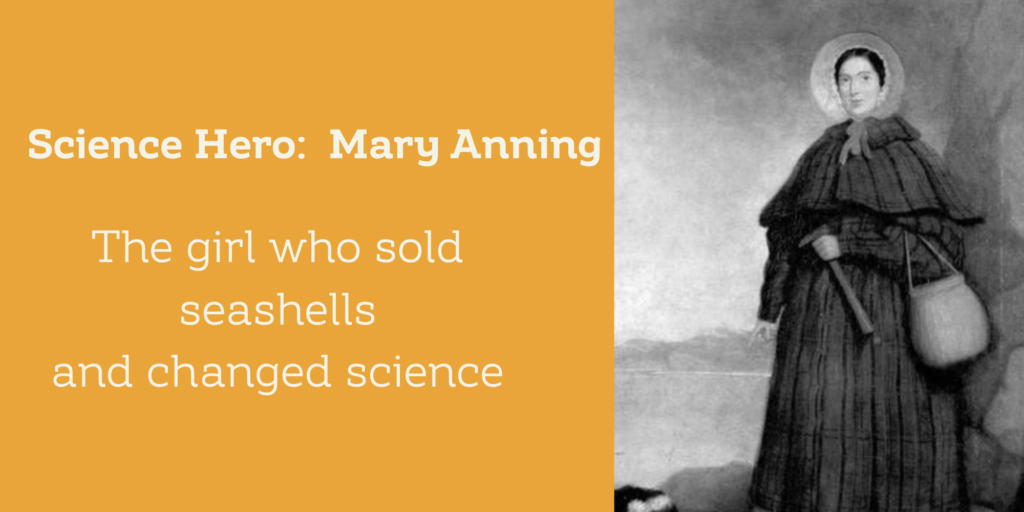
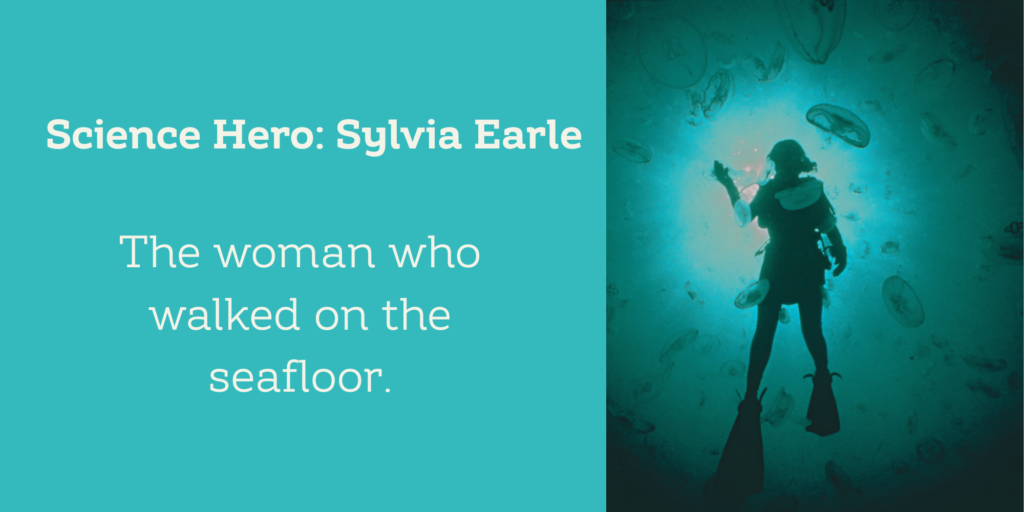
Inge Lehmann’s story is quieter than Mary Anning’s cliff-face discoveries or Sylvia Earle’s deep-ocean dives. But in some ways it’s one of the most powerful — because what she did was almost entirely invisible. Here’s what’s worth drawing out:
- Not all discoveries look dramatic. Inge didn’t go on an expedition. She sat at a desk and thought very hard about data that didn’t add up. Some of the most important scientific breakthroughs in history have looked exactly like that. The thinking is the work.
- Trust your evidence, even when others don’t. When Inge published her paper, many scientists doubted her. She didn’t change her conclusion just because the idea was unpopular. She kept building her case.
- Curiosity can last a lifetime. She worked until 75 and lived to 104. There was no point at which she decided she had learned enough.
- What we give girls access to matters. Inge’s father made sure she received an equal education at a time when most girls didn’t. That detail matters. What girls are taught to believe about their minds matters too.
Let her read it herself
I’ve put together a printable version of Inge’s story written specifically for girls — same voice as the Hey Smart Girl book series, no watering down, just one remarkable scientist’s story told in a way that’s made for her.
Print it out and leave it somewhere she’ll find it. Or sit down and read it together after she’s finished the seismograph experiment — the connection between the two lands beautifully if you do it in that order.
More hands-on science for curious girls
Pick one and do it this week — your future scientist will thank you.



Loved this topic?
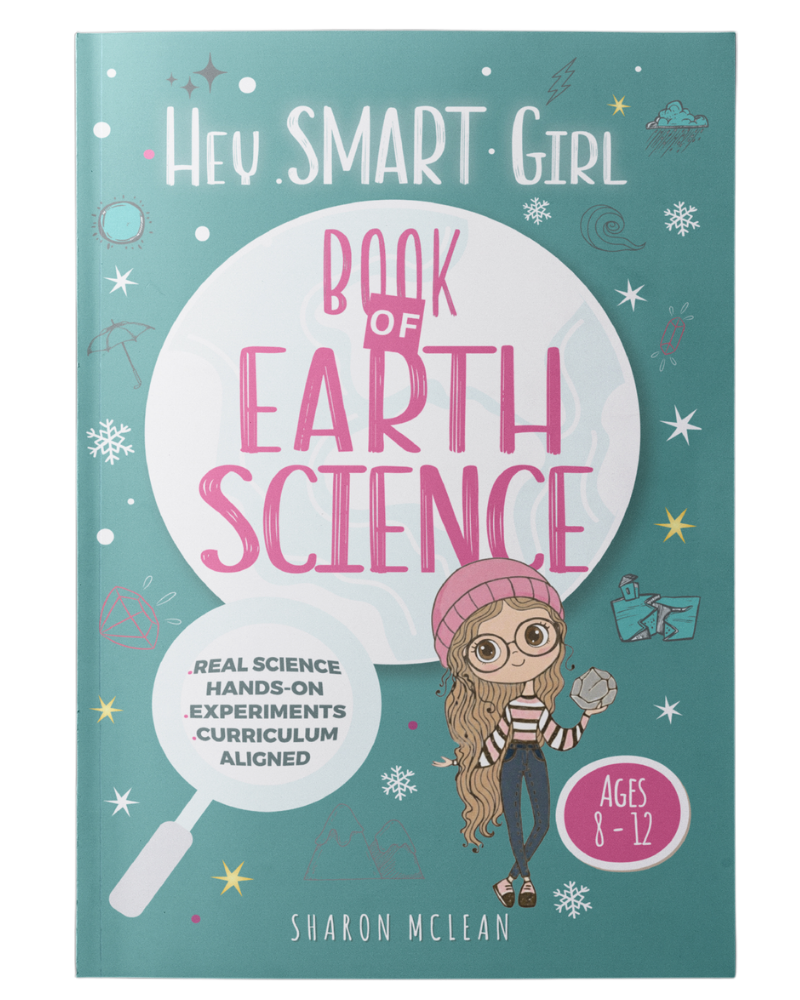
The Hey Smart Girl Book of Earth Science explores fossils, oceans, weather, earthquakes, climate, and the brilliant scientists who changed how we understand our planet.
Explore the Earth Science Book