Earth science is one of the best topics you can explore with a curious 8 to 12 year old — because it’s right there in front of them every single day. The weather, the rocks, the oceans, the sky. They’re already noticing it. Earth science just gives them the language and the understanding to go deeper.
But there’s another reason it’s such a valuable subject at this age. Earth science isn’t just about understanding our planet — it’s about understanding how to protect it. And that conversation starts earlier than most of us think.
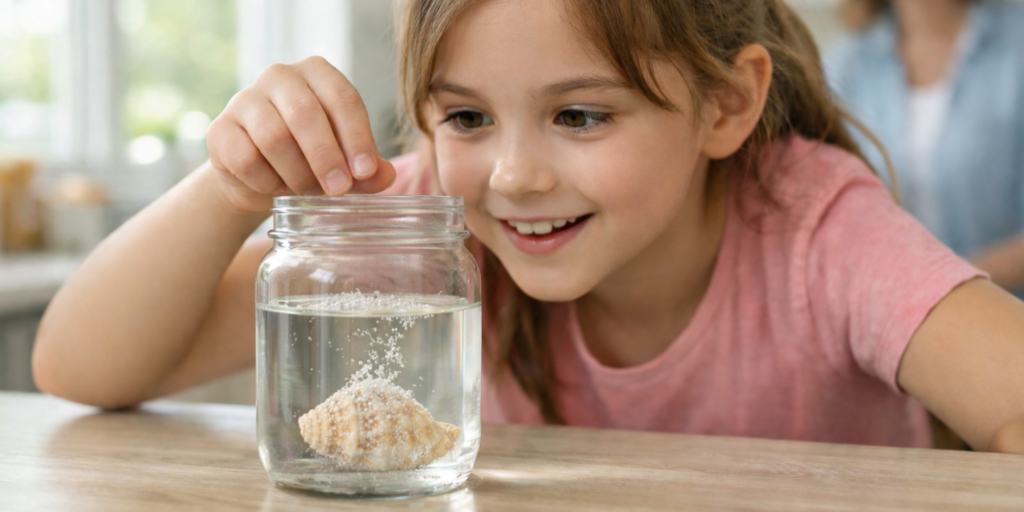
This experiment is a good place to start it. Pick up a seashell and hand it to her. Watch what happens — she’ll turn it over, run her fingers along the ridges, hold it up to the light. There’s something about a shell that invites curiosity without any prompting at all.
Now imagine that shell slowly dissolving. Not over millions of years — over days. That’s what this experiment shows. And the reason it happens is one of the most important science conversations you can have with her right now.
Ocean acidification isn’t a topic for university textbooks. It’s happening right now, in real time, in the oceans that cover more than 70% of our planet. Girls aged 8 to 12 are old enough to understand it, to care about it, and — this is the part worth holding onto — to do something about it.
What she’s going to learn
The oceans absorb roughly a quarter of all the carbon dioxide that humans release into the atmosphere every year. For a long time, scientists thought this was a good thing — the ocean acting as a giant sponge, soaking up the excess CO₂ from burning fossil fuels.
The problem is what happens when CO₂ dissolves in seawater. It forms carbonic acid. And as more CO₂ enters the ocean, the water becomes more acidic. Since the Industrial Revolution, ocean acidity has increased by about 26%.
That might not sound dramatic, but for marine life — particularly creatures with shells or skeletons made of calcium carbonate — it’s enormous.
Oysters, mussels, corals, sea urchins, tiny plankton — all of them build their shells and structures from calcium carbonate. In more acidic water, that material doesn’t form as easily. In some cases, existing shells begin to weaken and dissolve.
This experiment makes that visible. In a glass on your kitchen table, she’ll watch it happen in front of her. That’s a hard thing to unsee — and it shouldn’t be.
The experiment: The Disappearing Shell
Vinegar is a mild acid — similar in nature, though much stronger in concentration, to what’s happening in our oceans. Dropping a shell or a piece of chalk into vinegar lets her see the chemistry of ocean acidification in action, sped up dramatically so the process is visible within hours rather than decades.
What you’ll need
- 3 small glasses or jars
- White vinegar
- Water
- Salt (about 1½ teaspoons)
- 3 small seashells of similar size
- Optional: pieces of chalk or eggshell
- A notebook and pencil to record observations
What to do
- Start with a prediction: Before you begin, ask her what she thinks will happen to each shell. Which jar will do the most damage? Will saltwater change anything at all? Get her to write down her predictions first.
- Set up the jars: Fill the first jar with plain water. Fill the second with saltwater by stirring 1½ teaspoons of salt into a cup of water until dissolved. Fill the third with white vinegar. Label each jar clearly.
- Examine the shells: Look closely at each shell before it goes in. Notice the texture, colour, weight, ridges, and any tiny patterns. She can sketch or photograph them as her starting point.
- Place one shell in each jar: Put one shell into each liquid. In the vinegar jar, you should quickly see little bubbles forming on the shell. That’s the acid reacting with the calcium carbonate.
- Check back over time: Look again after a few hours, then the next morning, then after 24 and 48 hours. Ask her to record any changes she notices. Is the shell rougher? Softer? Thinner? Has the surface changed?
- Compare the shells: After 48 hours, remove them and line them up side by side. The vinegar shell should look the most damaged. The shell in water and the shell in saltwater should look much closer to how they started.
- Return to the prediction: Was she right? Partly right? Completely surprised? This is a brilliant moment to remind her that in science, unexpected results are often the most interesting ones.
Want to keep going?
If she wants to test more ideas, try swapping the vinegar for lemon juice or a fizzy drink. You could also compare a thick shell with a thin one, or a larger shell with a smaller one. Which dissolves faster? Which holds up best?
Every new version of the experiment creates a new question, a new prediction, and a new result to explain. That’s exactly how real science works.
Keep the questions coming
While you’re waiting, ask questions out loud. You don’t need all the answers — the thinking is the point.
- If the shell in vinegar is dissolving, what do you think might be happening to shells in the ocean?
- Coral reefs are made of calcium carbonate too — what could rising acidity do to them?
- If tiny ocean creatures can’t build their shells properly, what happens to the animals that eat them?
Why it matters — beyond the kitchen table
The ocean isn’t just a beautiful place. It helps regulate our climate, produces a huge share of the oxygen we breathe, and supports food chains across the planet. Some of the tiniest shelled organisms in the sea play an enormous role in keeping ocean ecosystems healthy.
When their shells weaken, the effects don’t stay small. The impact can ripple upward through the food chain, affecting fish, larger marine animals, and the balance of ocean life itself.
Helping her connect a dissolving shell in a jar to the health of the real ocean is one of the most powerful things science education can do. It makes the invisible visible. And once a child sees that connection, it sticks.
So what can she do about it?
Start by asking her. Once she’s seen the shell and understood what it means, ask what she thinks could help. She may have better ideas than you expect.
- Use less energy at home: Turning off lights, walking short distances, and wasting less energy all connect back to the same bigger picture.
- Think about food choices: Even one or two meat-free meals a week can help lower a family’s carbon footprint.
- Talk about it: Kids who understand a problem are more likely to care about it — and caring is where action begins.
- Learn more about ocean science: The more she understands the ocean, the more likely she is to want to protect it.
The ocean has looked after life on Earth for a very long time. She deserves to know that — and to know that looking after it goes both ways.
So once the experiment is done and the shell is sitting there on the counter, have the conversation. Ask her what she thinks. Ask her what she’d want to change. You might be surprised by how ready she is for it.
Loved this topic?
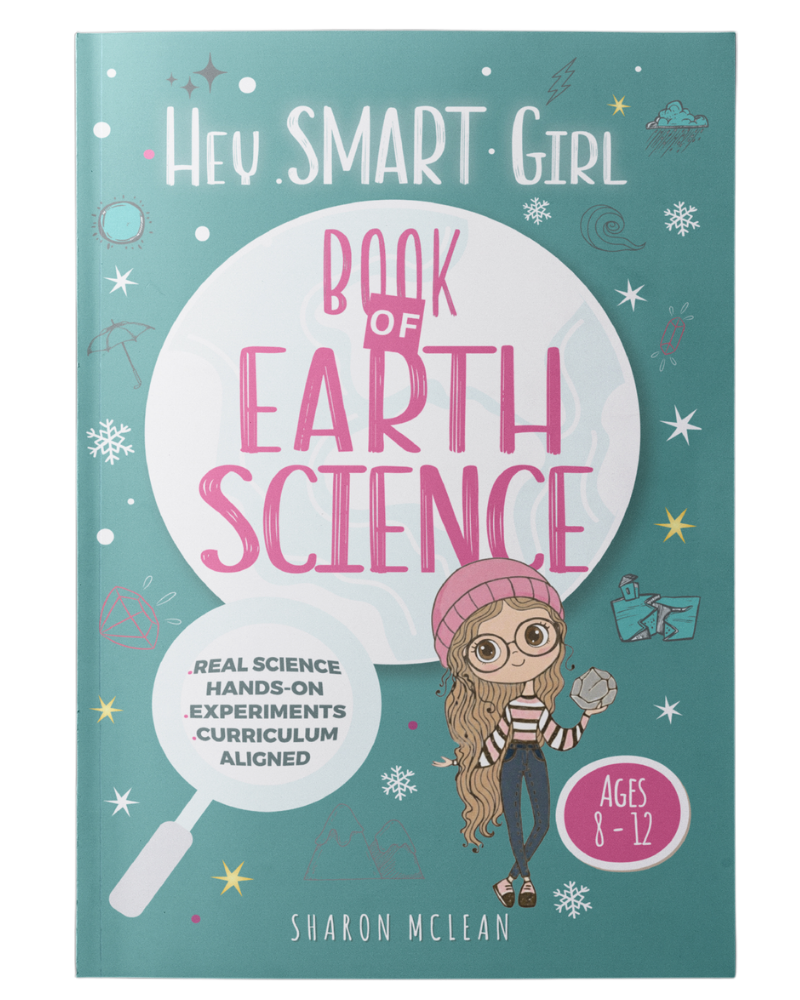
The Hey Smart Girl Book of Earth Science explores fossils, oceans, weather, earthquakes, climate, and the brilliant scientists who changed how we understand our planet.
Explore the Earth Science BookMore hands-on science for curious girls
Pick one and do it this week — your future scientist will thank you.