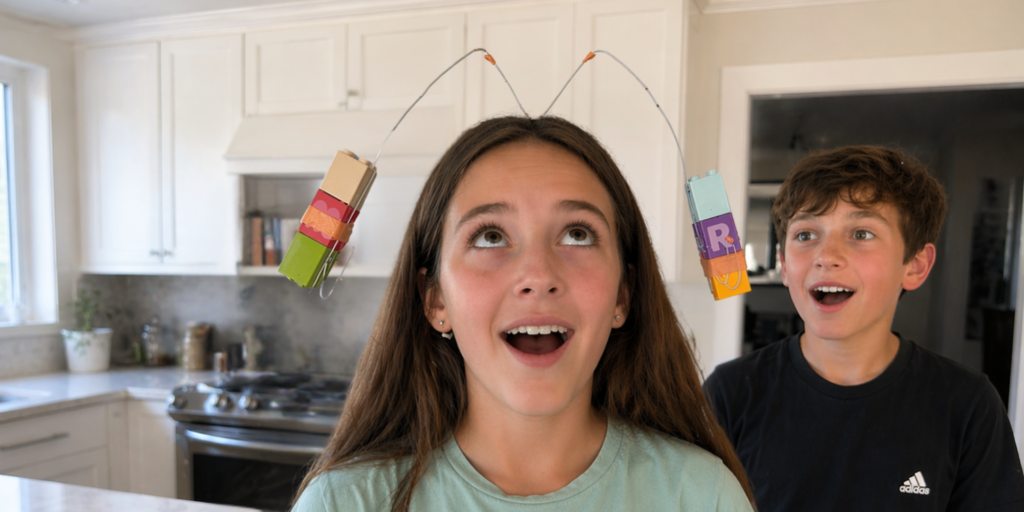
Here is a physics experiment that does something most experiments don’t — it gets put on someone’s head. Balance this contraption on top of your child, spin them around, and watch their face as the hat just sits there, completely unbothered, while everything else turns. The delight is instant, the science is real, and the argument over whose turn it is to wear it will last considerably longer than the experiment itself.
This is the Inertia Hat. It demonstrates Newton’s First Law of Motion in one of the most visual and interactive ways possible — and it takes about fifteen minutes to build from things you already have at home.
The science: Inertia — Newton’s First Law of Motion
The Law: An object at rest stays at rest, and an object in motion stays in motion — unless an external force acts on it. Objects resist changes to whatever they are currently doing. That resistance is called inertia.
What You Need
- One wire coat hanger — metal, not plastic. The wire needs to be firm enough to hold its shape
- Wire cutters or strong scissors to snip off the hook part
- Pliers to help straighten and bend the wire — optional but helpful
- A ruler and a marker
- Two equal weights to attach to each end — this is where you can get creative. Tennis balls work brilliantly. So do small stacks of Lego, toy figures, apples, or any two objects that are the same weight. The weights don’t matter as long as they match each other exactly — the whole thing depends on balance and symmetry
- String or tape to attach the weights to the wire ends
- Something to balance it on while you test it — a bottle, a stand, or a willing volunteer
The most important rule: Both sides must be identical in weight. If one side is heavier than the other the hat won’t balance and the experiment won’t work. Take your time getting this right before you move on.
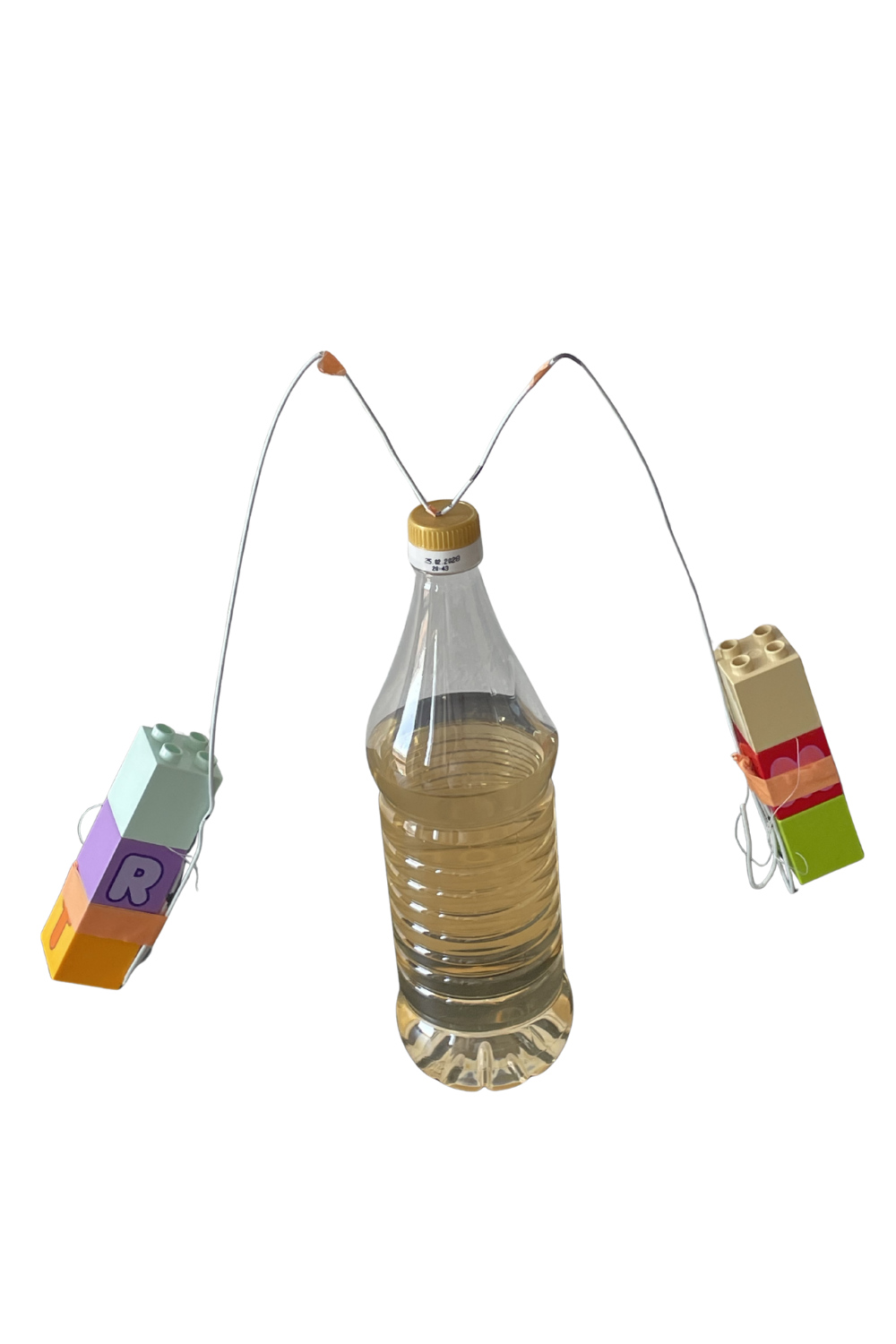
How To Build It
- Snip the hook off the coat hanger so you have a straight length of wire. An adult should do this part.
- Straighten the wire as much as possible using your hands and pliers. It doesn’t need to be perfectly straight but the flatter the better.
- Find the centre point of the wire and mark it. Then measure and mark 7cm out from the centre point on each side — so you have two marks, each 7cm from the middle.
- At those two marked points, bend the wire downward on both sides to create an M shape — the centre point is the lowest point of the M, and the two bends sit 7cm out on each side. The arms of the M extend outward and slightly upward from those bends. Take your time with this — the shape needs to be symmetrical on both sides.
- Attach one weight to each end of the wire, securing it firmly with string or tape. The weights must be at the same height on each side.
Test the balance before anything else: Place the centre point of the M on top of a bottle or a finger. It should sit level without tipping to either side. If it tips, adjust the weights or the wire shape until it balances perfectly. This step is worth being patient about — a well-balanced hat produces a much more dramatic result.
How To Do It
Once your hat is balanced, place the centre point gently on top of someone’s head. It should sit there without being held. Ask everyone watching — is the hat moving or staying still? Staying still. That is inertia. An object at rest stays at rest.
Now give one side of the hat a gentle push with your finger. Not too hard — you want it to orbit slowly and smoothly around the head. Watch what happens. It keeps going. Round and around, all by itself, without anyone touching it. Ask the question again — is it staying in motion or stopping? Staying in motion. That is also inertia. An object in motion stays in motion. It will keep spinning until friction from the wire resting on the head gradually slows it down and stops it. The stopping force is friction — without it, it would keep going indefinitely.
Let it come to a stop naturally. Now for the wow moment — ask the person wearing the hat to spin around slowly. Watch the hat. It stays completely still. The head turns underneath it. The weights hang in exactly the same position they started in, completely unbothered by all the spinning happening below them. Turn back the other way — same thing. The hat simply refuses to follow because nothing is applying a force to it directly.
This is the key question to ask your child: why did the hat spin when you pushed it with your finger, but not when the person spun around? The answer is everything. A force was applied directly in the first case. In the second case, nothing touched the hat — so it had no reason to move.
What To Watch
The key observation is the difference between the two scenarios. When the person spins, the hat stays put — the weights have no force acting on them directly so they stay exactly where they are. When you push the hat itself, it moves — because now a force is acting on it directly. That difference is inertia made visible in real time, on someone’s head, which is considerably more memorable than reading about it in a textbook.
The Science
The weights on each end of the wire want to stay exactly where they are. They are at rest. Nothing is pushing or pulling them directly when the person below spins — the only thing moving is the pivot point underneath them. Because the weights have mass, they resist the change in motion. The greater the mass, the greater the resistance. This is Newton’s First Law — inertia — and the M shape of the wire is specifically designed to keep the centre of gravity low and stable so the hat balances perfectly and the effect is as clear as possible.
When you push the hat directly you are applying a force to it — and it responds immediately because now something is actually acting on it. That is also Newton’s First Law. Objects stay still unless a force acts on them. Apply the force and they move. Remove the force and they stop again.
Why It Matters
Inertia is not just a physics experiment. It is one of the most important forces shaping the designed world around us. It is why seatbelts exist — your body wants to keep moving forward when the car stops suddenly. It is why ships take kilometres to slow down even after the engines cut out. It is why astronauts in space keep floating in the same direction indefinitely until something stops them. Understanding inertia is understanding why everything that moves behaves the way it does — and Newton worked it out over 300 years ago with a pen and paper.
Want To Go Further?
Try adding heavier weights to each end and see if the effect becomes more dramatic — more mass means more inertia, so the hat should resist the spinning even more strongly. Then try lighter weights and see if you notice a difference. You have just designed your own physics experiment with a variable.
You can also try a different shape — what happens if the arms of the wire are longer? Or shorter? Does the balance point change? This is exactly how physicists think.
A wire coat hanger, two matching weights, and fifteen minutes. That is all it takes to demonstrate one of the most fundamental laws in all of physics — in a way that your child will remember for years, largely because it was on their head.
Newton’s First Law is everywhere once you know to look for it. In every moving car, every orbiting satellite, every ship crossing the ocean. Today it was in your kitchen, balanced on someone’s head, completely ignoring all that spinning happening underneath it.
And if she’s the one who wanted to do it fifteen more times, who kept adjusting the weights and asking why it worked, who wanted to know what would happen if the arms were longer — keep watching that one. The astrophysicists and engineers of the future had to start somewhere. Today, she started in the kitchen. That is a very good place to begin.
More hands-on physics for curious girls
Pick one and do it this week — your future scientist will thank you.