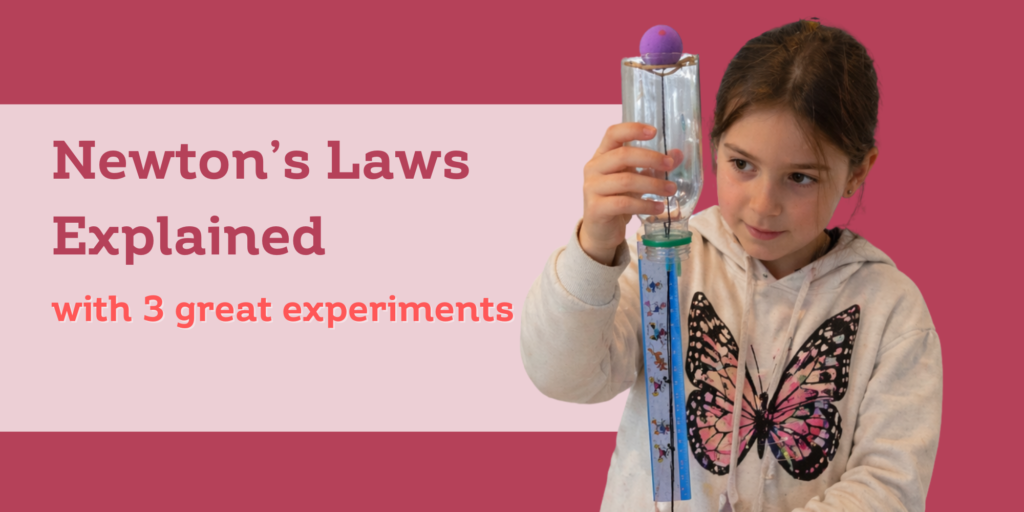
Newton wrote these laws over 300 years ago. Here’s why they still matter — and why your child needs to see them in action before they hit the classroom.
Newton’s Laws of Motion. How do you even begin to teach that? It sounds complex, it sounds overwhelming, and if we’re being completely honest — it sounds boring. Laws of motion. Forces and acceleration. F equals ma. It has the energy of a Monday morning double maths lesson and your child hasn’t even opened a textbook yet.
But here’s what nobody tells you. Newton’s three laws are actually some of the most interesting ideas in all of science. They explain almost everything that moves — from why you lurch forward when a car brakes suddenly, to how a rocket gets off the ground, to why a spinning egg does something that looks completely impossible the first time you see it. Once you see these laws in action they click in a way that no classroom explanation ever quite manages — because suddenly the laws aren’t abstract anymore. They’re happening right in front of you, on your kitchen counter.
These three activities will make Newton more interesting than the latest playground trend. Better still, the science will actually stick — because kids remember what they’ve done with their own hands far longer than anything they’ve read in a book. You need nothing special. Just a few things from around the house, a curious kid, and about twenty minutes.
Let’s go.
Activity 1: The Spinning Egg
Newton’s First Law — The Law of InertiaWhat You Need
- One raw egg and one hard-boiled egg — mark the hard-boiled one with a small pencil dot so you can tell them apart
- A smooth flat surface — a glass chopping board or smooth kitchen counter works best
How To Do It
Place both eggs on the surface and spin them as fast as you can, one at a time. Then, while each egg is still spinning, press your fingertip gently on top to stop it — and immediately lift your finger away.
What To Watch
The hard-boiled egg stops and stays stopped. The raw egg does something completely unexpected — it starts spinning again on its own the moment you lift your finger. Your child will want to do this about fifteen times. That is completely normal.
The Science
Inside a hard-boiled egg, everything is solid. When you stop the shell, the whole egg stops with it. But inside a raw egg there is liquid. When you press on the shell, the shell stops — but the liquid inside is still spinning, because nothing has stopped it. The moment you lift your finger, that still-moving liquid drags the shell back into motion. That tendency of a moving object to keep moving is called inertia, and it is Newton’s First Law doing exactly what it says.
Why It Matters
Inertia is the reason seatbelts exist. When a car stops suddenly the car stops — but the passengers inside want to keep moving forward at the same speed the car was travelling. The seatbelt is the force that stops them. Understanding inertia has shaped the design of everything from aircraft landing gear to earthquake-resistant buildings. Newton published this law over 300 years ago and engineers are still using it every single day.
Activity 2: The Elastic Launcher
Newton’s Second Law — The Law of Acceleration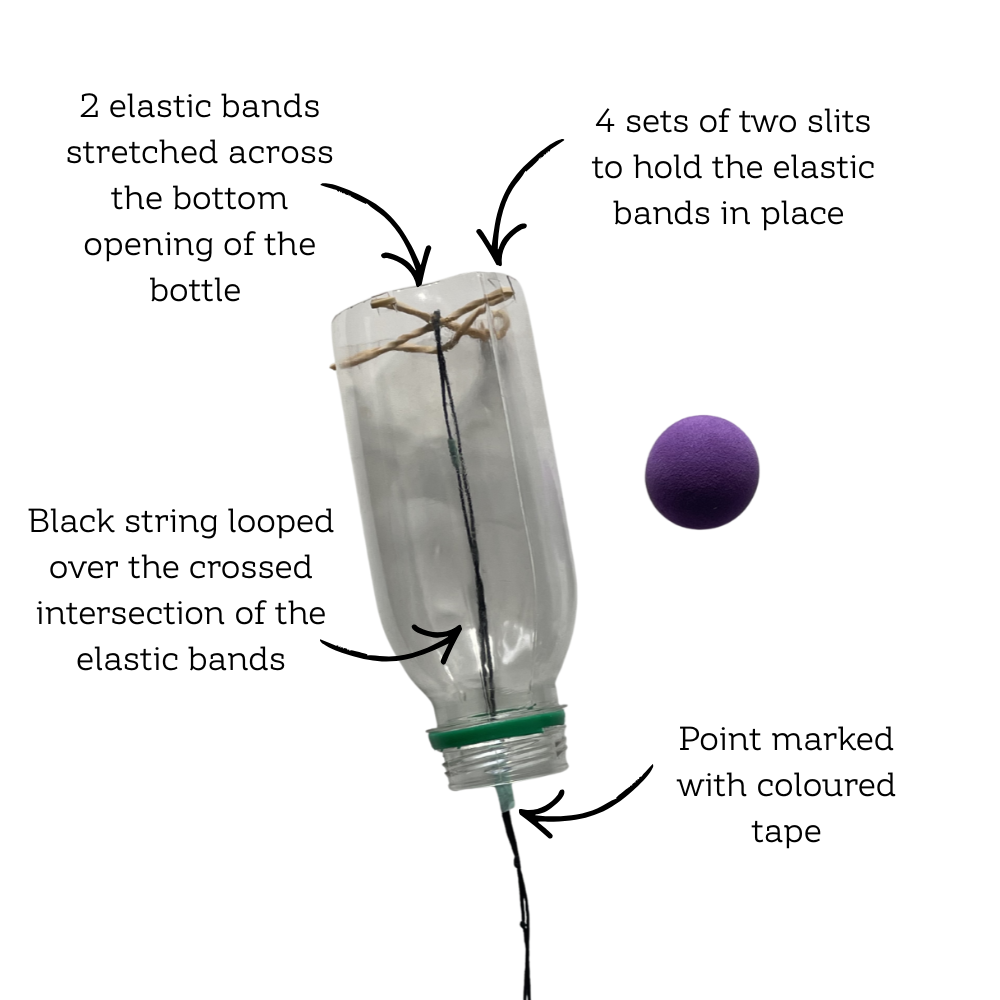
What You Need
- A small smoothie bottle — the firm, thick plastic holds up well under the tension of the elastic bands. A milk bottle won’t work as the plastic is too soft. Whatever bottle you use, the plastic must be strong enough to hold two stretched elastic bands without buckling. If you’re not sure, wrap a few layers of strong tape firmly around the rim for reinforcement — just make sure the tape does not come into contact with the elastic bands themselves
- Two elastic bands of the same size
- A piece of string or thin twine about 40cm long
- A ruler
- A small piece of coloured tape
- A ball small enough to sit on the elastic bands without falling through the gaps and small enough to fit within the bottle opening — we used a small purple foam ball roughly the size of a ping pong ball (the kind that comes with a toy gun). The right size ball depends entirely on your bottle, so test a few before you start
How To Build It
Cut the bottom off the plastic bottle cleanly. At four equally spaced points around the cut edge, cut two small slits close together — about 5mm apart. Thread the elastic band down through the first slit and back up through the second to lock it securely in place. Do this at all four points — two positions for each elastic band — so that each band is firmly anchored at both ends and won’t slip under tension.
Stretch the two elastic bands across the opening at right angles to each other so they form a cross shape in the centre. Loop the string up and over the point where the elastic bands intersect, so it is held in place by the cross. Thread the other end of the string down through the bottle and out through the neck. Wrap a small piece of coloured tape around the string near the neck of the bottle — this is your measurement marker and it also holds the two ends of the string neatly together.
How To Do It
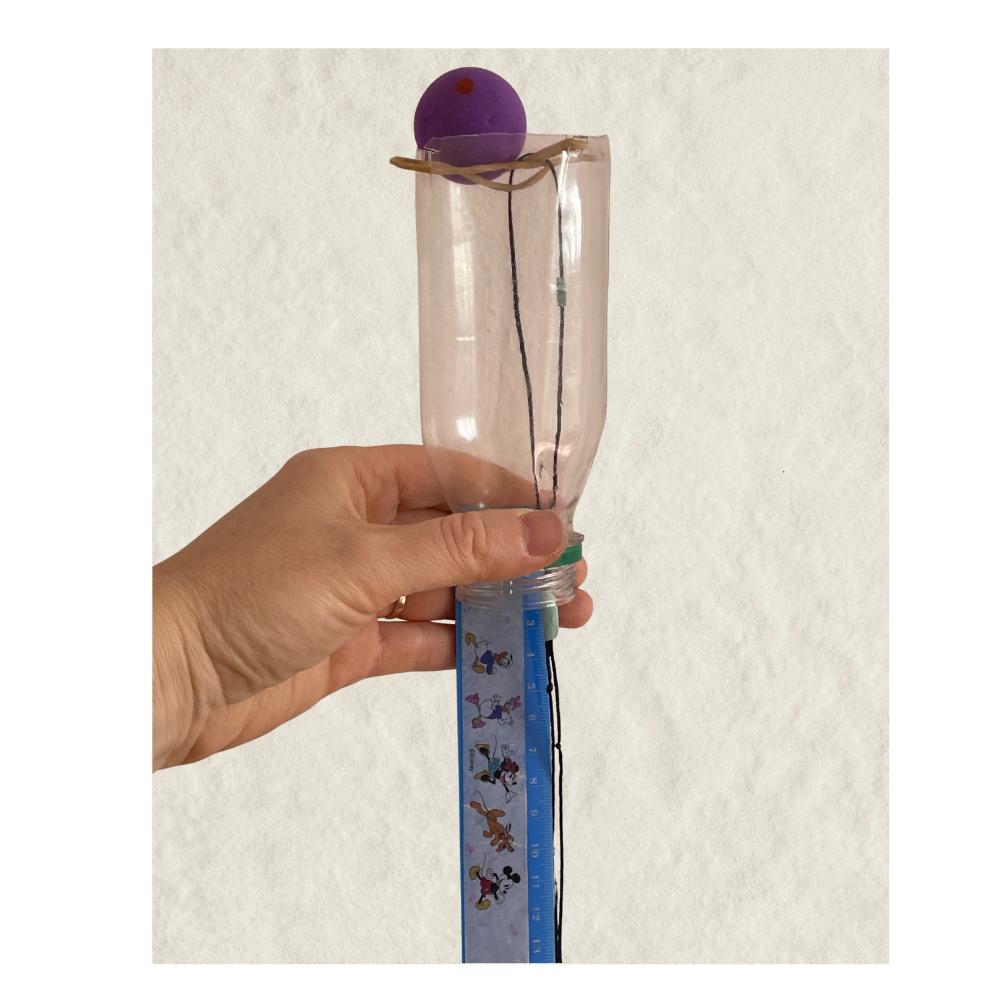
Hold the launcher upright with the cut end facing up, using a wall behind you for support. Hold the ruler alongside the string hanging from the bottle neck, or tape it to the side of the bottle. Place the ball on the elastic bands at the top.
Pull the string down until your coloured tape marker lines up with the 5cm mark on the ruler. Release. Watch how far the ball travels and mark the landing spot.
Now repeat — this time pulling the string down to the 10cm mark. Release. Mark the landing spot. Compare the two.
What To Watch
The ball launched from the deeper pull accelerates faster and travels significantly further. Same ball, same launcher, same everything — the only thing that changed was the force applied. Watch what that single change does to how far it flies. That difference in distance is Newton’s Second Law made visible.
The Science
By pulling the string to a measured point on the ruler every single time, you are controlling the force precisely. Pull further, stretch the elastic more, store more energy, release more force. More force acting on the same mass produces greater acceleration — the ball moves faster and travels further. This is F = ma. The ruler and the coloured tape marker are what make this real science rather than just a fun launcher — one variable changed, everything else kept constant, results compared. That is the scientific method, and your child just used it.
Want To Go Further?
If you have two balls of a similar size but noticeably different weights, try launching both from the same measured pull point. The lighter ball should travel further — same force, less mass, more acceleration. F = ma, this time with mass as the variable.
Why It Matters
Newton set F = ma down as a law of physics over 300 years ago. Since then science has split the atom, mapped the human genome, and put humans on the Moon — and not one advancement has come close to disproving it. F = ma remains unfaltered, undeniably true, and one of the most used equations in engineering today. It is used to calculate the thrust needed to launch a rocket, the braking force required to stop a train, the impact force of a car crash, and the power needed to lift a crane. Every engineer who has ever designed anything that moves has used this equation.
Activity 3: The Balloon Rocket
Newton’s Third Law — The Law of Action and ReactionWhat You Need
- A long piece of string or fishing line — at least 3 to 4 metres
- A plastic straw
- A balloon — long thin balloons work better than round ones
- Two pieces of tape
How To Do It
Thread the straw onto the string before tying it off. Tie one end of the string to a door handle, chair back, or any fixed point, and stretch it as tightly as you can across the room, tying the other end at the same height. The string must be genuinely taut — a saggy string will kill the momentum before the balloon gets going.
Blow up the balloon but do not tie it. Pinch the end shut with your fingers. Tape the balloon firmly to the straw with two pieces of tape, one at each end. Still pinching the balloon closed, slide the straw to one end of the string. Let go.
What To Watch
The balloon shoots along the string the moment you release it, propelled entirely by the air rushing out of the back. Try it with different amounts of air. Try a round balloon versus a long one. Let your child predict which will go further before each launch — they will start forming hypotheses without even realising it.
The Science
The balloon pushes air out backwards. The air pushes back against the balloon with exactly equal force in the opposite direction — forwards. There is no engine, no fuel combustion, no wheels. Just Newton’s Third Law. The action is air being pushed out. The reaction is the balloon being pushed forward. The two forces are always equal. Always opposite. Always.
Why It Matters
This is not a simplified version of how rockets work. It is exactly how rockets work. Every rocket ever launched — from the earliest experimental rockets to the Saturn V that carried astronauts to the Moon, to the rockets putting satellites into orbit today — runs on this single principle. Hot gas pushed out the back at enormous speed. The rocket pushed forward with equal force. The string across your living room is optional. The physics is non-negotiable.
So — How Did You Get On?
Did the spinning egg get the reaction you were hoping for? Did the launcher end up taking over the kitchen for a full hour? Did the balloon rocket make it all the way across the room or did it stall halfway and send everyone back to adjust the string? Whatever happened, something useful happened — because your child now has a physical memory of these laws. Not a definition memorised from a page. An actual memory of seeing them work.
Newton wrote these three laws down over 300 years ago in a book called Principia Mathematica — one of the most important scientific works ever written. He had no computer, no modern laboratory, and absolutely no idea that centuries later a child would be proving him right in a kitchen. But that is the thing about real science. It does not go out of date. The same laws Newton used to describe a rolling ball are the ones NASA uses today to calculate a course to Mars.
Physics is not something that only happens in laboratories. It is happening in your car, your kitchen, and your living room every single day. Today your child saw it.
And if she’s the one who wanted to do the balloon rocket fifteen more times, who kept adjusting the string tension and asking why it went faster with more air, who wanted to know what would happen if the launcher was tilted at an angle — keep watching that one. The astrophysicists and rocket engineers of the future had to start somewhere. Today, she started in the kitchen. That is a very good place to begin.