Imagine solving one of the biggest scientific mysteries of the twentieth century.
Imagine your discovery changing the world forever — leading to nuclear power, medical treatments, and a complete rethinking of what matter actually is.
Now imagine watching your male colleague collect the Nobel Prize for your work. While you weren’t even mentioned.
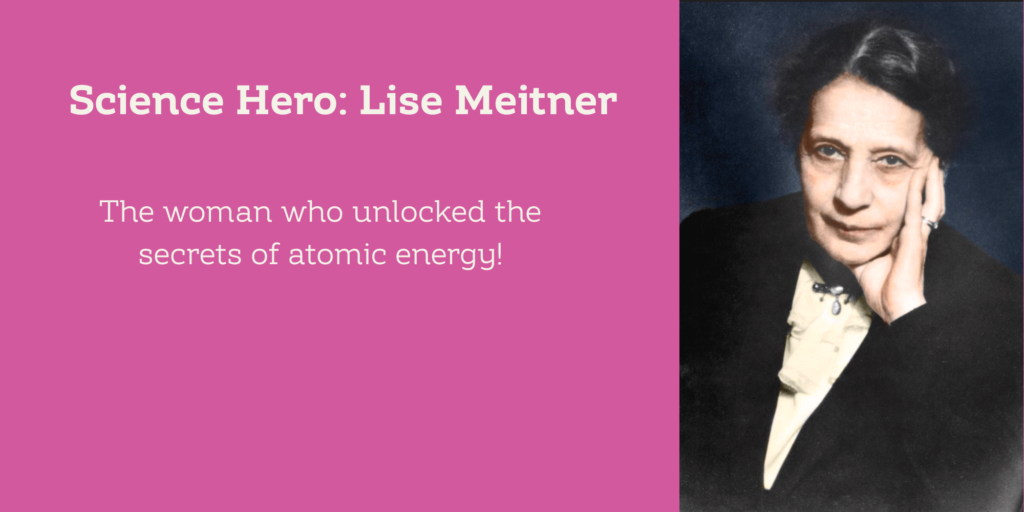
That is exactly what happened to Lise Meitner.
And your daughter deserves to know her name.
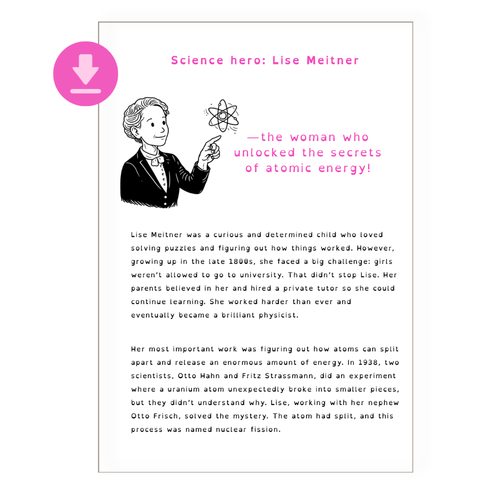
Want the printable story card?
The story
Lise Meitner was born in Vienna in 1878, the third of eight children. From a young age she was fascinated by mathematics and science — but in Austria at that time, girls weren’t allowed to attend university.
She studied privately, passed the entrance exam anyway, and became only the second woman ever to earn a physics doctorate from the University of Vienna.
She moved to Berlin to study under Max Planck — one of the greatest physicists in history. He initially told her women didn’t belong in science. She ignored him and became one of his most respected students.
For thirty years, she worked alongside chemist Otto Hahn at the Kaiser Wilhelm Institute in Berlin. She was brilliant. She was productive. And for much of that time, she wasn’t allowed to use the main entrance of the building — she had to use a side door reserved for women.
She kept working anyway.
In 1938, when the Nazis came to power, Lise — who was Jewish — had to flee Germany overnight with almost nothing. She escaped to Sweden, where she continued her work in exile.
That same year, Otto Hahn conducted an experiment that confused him completely. He bombarded uranium with neutrons and the atom appeared to split into smaller pieces. He didn’t understand why. He wrote to Lise.
Working with her nephew Otto Frisch over Christmas, Lise solved it. The uranium atom had split — releasing an enormous amount of energy. She named the process nuclear fission and calculated the energy released using Einstein’s equation.
It was one of the most important scientific discoveries of the twentieth century.
In 1944, the Nobel Prize in Chemistry was awarded for the discovery of nuclear fission.
It went to Otto Hahn alone.
Lise Meitner’s name was not mentioned.
She never won a Nobel Prize.
But in 1997, the scientific community named a newly discovered chemical element after her — Meitnerium (Mt), element 109 on the Periodic Table.
Only a handful of scientists in history have had that honour.
The science — what did she discover?
Lise Meitner discovered that when a uranium atom is struck by a neutron, it can split into two smaller atoms — releasing a huge amount of energy in the process.
This is called nuclear fission.
The energy released comes from the tiny difference in mass between the original atom and the two new ones. That lost mass converts directly into energy — exactly as Einstein’s famous equation E=mc² predicts.
Nuclear fission is the principle behind nuclear power stations, which today generate about ten percent of the world’s electricity. It is also used in nuclear medicine — the technology that makes certain cancer treatments and medical scans possible.
Lise Meitner understood all of this before almost anyone else.
Why it matters today
Nuclear fission changed everything.
It powers cities. It treats cancer. It helped us understand the fundamental nature of matter.
And it was figured out by a woman who had been told she didn’t belong in science, who had to flee her country in the middle of the night, who did her most important work in exile — and who still didn’t get the credit.
Lise Meitner’s story is a reminder that the history of science is full of women whose contributions were overlooked, minimised, or handed to someone else.
Knowing their names is one small way of putting that right.
What your daughter can take from this story
- She was told no — repeatedly. She wasn’t allowed into university. She wasn’t allowed to use the front door. She kept going anyway.
- She did her best work in the hardest circumstances. She solved nuclear fission while in exile, at Christmas, with almost nothing.
- The recognition came late — but it came. An element on the Periodic Table bears her name. That doesn’t go away.
- Curiosity and persistence matter more than permission. Nobody gave Lise Meitner a clear path. She made her own.
Let her read it herself
Download the printable version of Lise’s story — written just for girls.
More hands-on physics for curious girls
Pick one and do it this week — your future scientist will thank you.


Loved this topic?
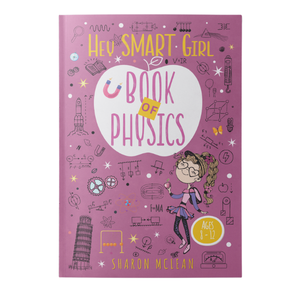
The Hey Smart Girl Book of Physics explores forces, motion, light, sound, electricity, and the brilliant scientists — including women like Lise Meitner — who changed how we understand our universe.
Explore the Physics Book