
You know that moment when your child asks you something completely out of nowhere — usually at dinner, usually when you have a mouth full of food — and you think, I genuinely have no idea how to answer that?
What if, just once, you were the one with the jaw-dropping answer?
That’s what this post is for. Twenty-five physics facts that are genuinely astonishing — the kind that stop a conversation dead, make your daughter look at you like you might actually be brilliant, and just might spark a curiosity in her that lasts a lifetime.
No jargon. No equations. Just the good stuff, with a little bit of the science behind it so you actually understand why it’s extraordinary.
Grab a coffee. These are worth savouring.
Want these facts as a printable card for your daughter?
Light and speed
1. Light could circle the Earth seven times in a single second.
Light travels at 186,000 miles per second. Not per hour — per second. To put that in perspective, it takes sunlight about eight minutes to travel the 93 million miles from the Sun to Earth. The fact that we feel warm in the garden is because of light that left the Sun while you were still drinking your morning coffee.
2. In 1999, a scientist slowed light down to 38 miles per hour — slower than a bicycle.
Danish physicist Lene Hau fired a laser beam through a cloud of atoms cooled to near absolute zero. The atoms acted like thick syrup, forcing the light to crawl. 38 miles per hour. Your child on a bike could theoretically race it — and win.
Two years later, her team stopped light completely — like pressing pause on the universe — held it perfectly still, and then let it go again. If that doesn’t deserve a moment of quiet awe, nothing does.
3. White light is actually seven colours mixed together.
Every rainbow you’ve ever seen was hiding inside ordinary white light the whole time. A raindrop — or a prism — bends each colour by a slightly different amount, pulling them apart to reveal red, orange, yellow, green, blue, indigo, and violet. The science was in the sunlight all along. It just needed something to tease it apart.
4. There are mirrors on the Moon — and we still use them.
Apollo astronauts placed special reflectors on the Moon’s surface during the 1969, 1971 missions. Scientists on Earth shoot lasers at them, measure how long the light takes to bounce back, and calculate the exact distance to the Moon. They’re called retroreflectors, and they still work today.
Thanks to this experiment, we know the Moon is slowly drifting away from Earth by about 3.8 cm every year. It’s been moving away since it formed billions of years ago — quietly, steadily, a little further each year.
Sound and waves
5. Sound travels over four times faster in water than in air.
In air, sound moves at around 343 metres per second. In water, it hits 1,480 metres per second. In solid metal, it can reach 5,000 metres per second or more. The closer together the particles, the faster the vibrations pass between them.
Try this with your daughter: put your ear against a table and have someone tap the other end. The sound through the solid wood arrives noticeably faster and louder than the same tap heard through the air. Two seconds, no equipment, instant physics lesson.
6. Sound travels further at night than during the day.
At night, the air near the ground is cooler than the air higher up. Sound waves naturally bend towards cooler air, which means they get trapped near the ground instead of spreading upwards and dispersing. The result is that sounds carry further and seem louder. Those things that go bump in the night probably go bump during the day too — you just can’t hear them quite so well.
7. In space, nobody can hear you scream.
Sound needs a medium — air, water, or solid material — to travel through. Space is a near-perfect vacuum, with almost no particles for vibrations to pass between. There is no sound in space whatsoever. Complete, unbroken silence across billions of miles.
This also means every dramatic explosion in a space film is completely physically impossible. Real space battles would be entirely silent. Less cinematic, but the physics is honest.
8. The smallest bones in your body are inside your ear.
Three tiny bones — the hammer, the anvil, and the stirrup — sit deep inside your ear canal. The stirrup, the smallest of the three, is smaller than a grain of rice. Their entire job is to pick up sound vibrations and pass them on to your inner ear. Your ability to hear music, voices, and the world around you depends on something the size of a crumb doing its job perfectly, every second of every day.
9. Dolphins build a picture of the world entirely from echoes.
Dolphins send out high-frequency clicking sounds, then listen to the echoes that bounce back. From those echoes alone, they can determine the size, shape, distance, and texture of objects around them — including fish hiding in the sand. Their natural sonar is more precise than most technology humans have built.
Some blind people have taught themselves to do the same thing, using tongue clicks to echolocate and build a mental picture of their surroundings just from sound. Humans learning from dolphins. Science at its best.
Electricity and magnetism
10. Your body is running on electricity right now.
Every thought you have, every movement you make, every dream you dream — all of it is powered by tiny electrical signals firing through your nervous system. Your brain is processing this sentence right now using the same fundamental force that powers your phone. You are, in the most literal sense, a walking circuit board.
11. When you shuffle across a carpet and zap someone, that’s the same physics as a lightning bolt.
Rubbing your feet on carpet builds up extra electrons — a negative charge — on your body. Touch something (or someone) and those electrons jump across. Same charge, massively different scale, but exactly the same physics that lights up a stormy sky.
Try it in the dark — you might see a tiny blue spark. It works best in dry air. In humid air, moisture drains the charge away before it can build up, so no spark, no drama. Another reason Italian summers feel different to Irish winters.
12. Deep inside Earth is a molten metal core — and that’s what makes compasses work.
The movement of liquid iron in Earth’s outer core generates a magnetic field that wraps around the entire planet. Every compass needle is a tiny magnet lining itself up with that field, pointing north. The whole Earth has been a giant magnet for billions of years. Compasses just noticed.
13. Niagara Falls generates enough electricity to power nearly four million homes.
Moving water spins turbines, turbines spin magnets inside coils of wire, and that spinning motion generates electricity. Nikola Tesla proved this could be done at Niagara Falls in the 1890s, providing power to entire cities for the first time. Today, one of the world’s most famous electric car companies is named after him.
That’s like lighting up San Francisco, Seattle, and Boston combined — all from water falling over a cliff. Renewable energy isn’t a new idea. It’s a very, very old one finally getting the attention it deserves.
14. A lightbulb in a California fire station has been glowing since 1901.
Over 120 years of continuous light. Known as the Centennial Bulb, it has outlived entire generations of people, and scientists still aren’t entirely sure why it’s lasted so long when modern bulbs burn out in a few years. It even has its own website with a live webcam so you can watch it glow right now. A lightbulb with its own dedicated fan following. We love to see it.
15. If you leave a magnet out overnight and run it over a white sheet in the morning, you might find tiny pieces of space.
Earth is constantly being hit with tiny fragments of asteroid, many of which contain iron and nickel — both magnetic metals. These micrometeorites land on rooftops, gardens, and sheets left out at night. Space dust settles on your house. Quietly. Every single night.
This is a genuinely brilliant thing to try with children. A strong magnet, a white sheet left outside overnight, and the following morning — patience and curiosity rewarded with something that has travelled millions of miles.
Heat and energy
16. If you leave the fridge door open, the room gets warmer — not colder.
A fridge doesn’t create cold. It moves heat — pulling it from inside and releasing it at the back. Leave the door open and the motor works harder, pumping even more heat into the room than it removes. The room gets warmer. Physics: occasionally inconvenient, always honest.
17. Metal doesn’t feel colder than wood — it just takes heat from your hand faster.
Pick up a metal spoon and a wooden spoon that have been sitting in the same room. The metal feels noticeably colder, but both are exactly the same temperature. Metal is simply a better conductor of heat, so it draws warmth away from your hand more quickly, creating that cold sensation.
This is one of those facts that sounds wrong until you actually try it — which makes it perfect dinner table material. Do the experiment, then explain what’s actually happening. Instant credibility.
18. You can cool water below freezing without it turning to ice — and then freeze it instantly with a single tap.
If pure, still water is cooled very gently below 0°C, it can remain liquid even below its freezing point. There’s nothing for ice crystals to form on — no dust, no bumps, no disturbance. The moment you shake it or drop something in, it freezes before your eyes.
This is called supercooling, and you can actually try it at home with distilled water and a careful hand with the freezer timer. One of the most visually dramatic science experiments you can do in a kitchen. Worth looking up.
19. There is a fourth state of matter — and it’s what lightning is made of.
Solid, liquid, gas — and plasma. When matter is heated beyond gas, its atoms lose electrons and become plasma: a supercharged, electrically charged state of matter. Lightning is plasma. The Sun is plasma. Stars are plasma. Plasma is actually the most abundant state of matter in the entire universe — we just don’t encounter much of it down here on Earth, which is probably fortunate.
20. A 15-year-old girl invented a torch powered entirely by body heat.
Ann Makosinski was 15 when she found out her friend in the Philippines couldn’t study at night because she had no electricity. So she invented a solution: a torch powered by nothing but the warmth of a human hand. No batteries, no charging — just thermoelectric generators converting body heat into light.
She won international awards, appeared on major TV programmes, and went on to study at university — and she has said she wasn’t even particularly good at science in school. She was just curious, and she cared about a problem. That’s the whole story.
Forces, motion and the living world
21. If you drop two objects of different weights from the same height, they hit the ground at the same time.
Gravity pulls everything toward Earth at the same rate, regardless of mass. A bowling ball and a tennis ball, dropped together, land together — as long as air resistance isn’t a factor. Galileo proved this in the 1600s, challenging over 2,000 years of accepted wisdom in the process.
Try it with two books of different weights, dropped from the same height onto a hard floor. The sound of them landing is the test. Most people predict the heavier one lands first — and most people are wrong. Galileo was a troublemaker in the best possible way.
22. Wood frogs freeze almost solid in winter — heart stopped, no breathing — and come back to life in spring.
Parts of their bodies, including their organs, actually freeze. No heartbeat. No breathing. No movement. Then the temperature rises and they simply wake up. They survive this by producing a natural antifreeze from sugars in their blood, which protects their cells from ice crystal damage. Scientists have studied this process to develop better techniques for preserving donor organs for transplant. A frog hibernating under leaves is helping save human lives.
23. Arctic fish produce antifreeze proteins in their blood.
Living in waters that would freeze the blood of most fish, Arctic species evolved proteins that stop ice crystals from forming inside their bodies. The science behind these proteins has informed medical research into organ preservation and cryogenics.
Nature has been solving complex physics and chemistry problems for millions of years. Scientists study it not just out of curiosity, but because the solutions already exist — they just need to be found.
24. The Leaning Tower of Pisa was never meant to lean.
Construction began in 1173 on soft, unstable ground, and the tower started tilting before it was even finished. Engineers have been using physics to slow and manage the lean ever since — and they’ve done it so successfully that the tower is now stable and expected to stand for at least another 200 years. It’s famous precisely because of a structural mistake, and it’s still standing because of science. Sometimes getting it wrong is how you end up in the history books.
25. Only 20% of university engineering and computer science students are girls.
Four out of five of the people being trained right now to solve the world’s biggest problems — clean energy, climate change, medical technology, quantum computing — are boys. Not because girls aren’t capable. You’ve just read 24 facts that are every bit as fascinating to a curious girl as to anyone else. The gap exists for other reasons, which means it can close.
The science suggests that one of the most powerful things a parent can do is simply talk about science with their daughter — casually, regularly, and as though it naturally belongs to her. Not as a lesson. Just as a conversation. Like this one.
The bit that matters most
None of these facts require a science degree to share. You don’t need to know the formula or the full explanation. You just need to say, at dinner, or in the car, or before bed: “Did you know there are mirrors on the Moon — and we still bounce lasers off them?”
That’s it. That’s the whole lesson. Curiosity is contagious, and it doesn’t need a classroom to spread.
The engineers and scientists of the next generation won’t all come from families who understood physics. They’ll come from families where someone thought it was worth talking about.
That someone can be you. Starting tonight.
More hands-on physics for curious girls
Pick one and do it this week — your future scientist will thank you.

Let her read them herself
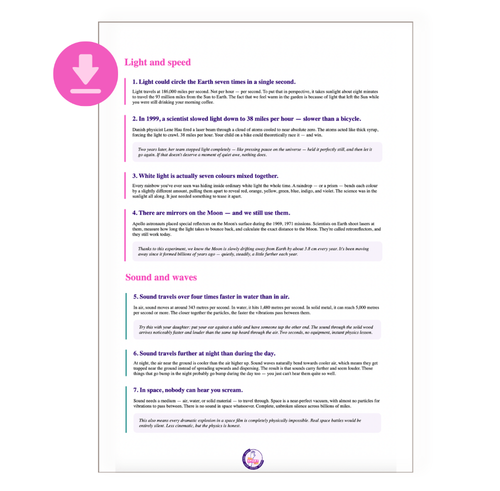
Download the printable version of all 25 facts — written directly for girls, ready to share.
Loved this topic?
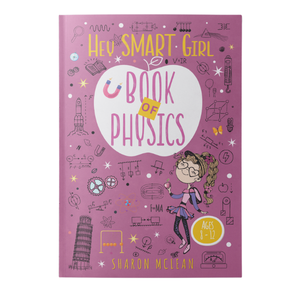
The Hey Smart Girl Book of Physics is packed with over 30 hands-on experiments, stories of real women scientists, and everything a curious girl aged 8–12 needs to understand the forces, energy, and laws that power our world.
Explore the Physics BookFAQs
What age are these physics facts suitable for?
Most of these facts can be shared with children from around age 7 or 8 upwards — the concepts don’t require any prior science knowledge, and the asides give you just enough background to answer the inevitable follow-up questions. The Hey Smart Girl Book of Physics is written specifically for girls aged 8–12 and goes into all of these topics in much more depth, with experiments to match.
How do I get my daughter interested in science without it feeling forced?
The most effective thing is to treat science as normal dinner table conversation rather than a formal subject. Share a fact, let it land, and follow the conversation wherever it goes. You don’t need to have all the answers — curiosity is more contagious than knowledge. Our post on the benefits of STEM for girls has more on this if you’re interested.
Are there easy physics experiments we can try at home?
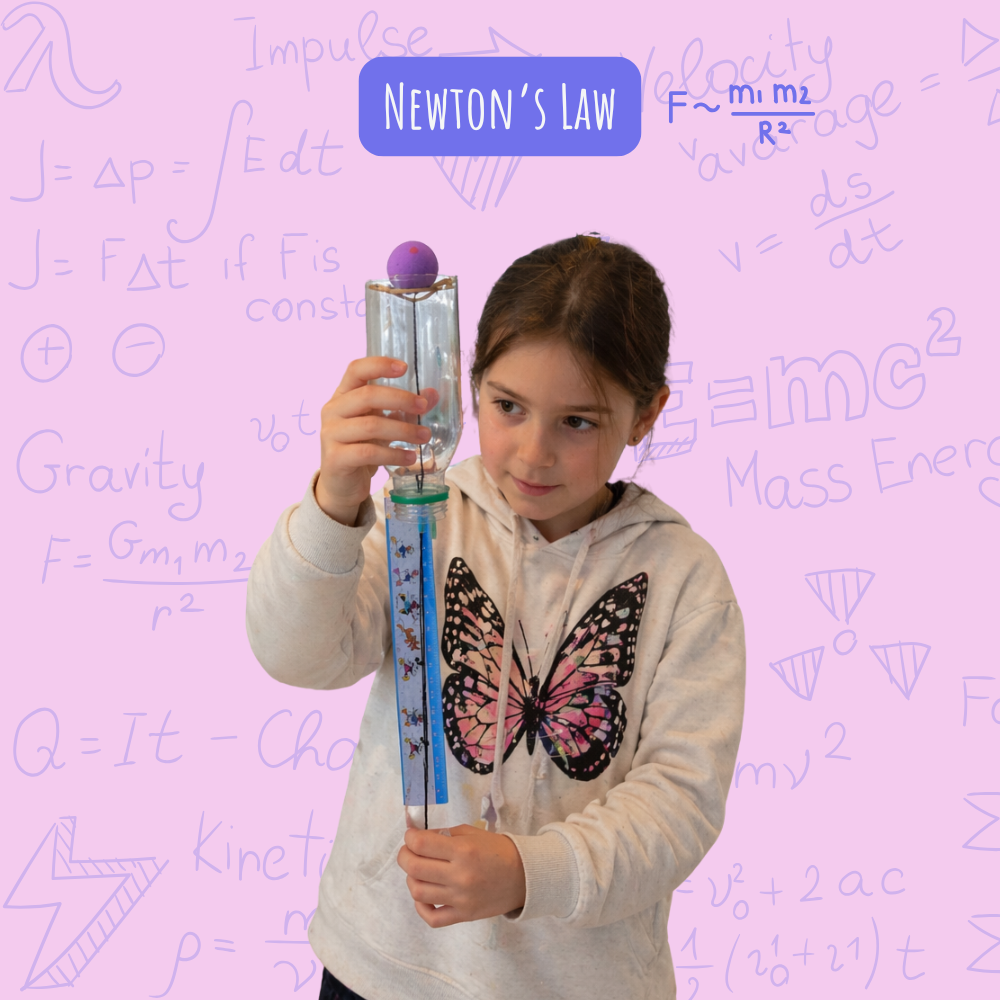
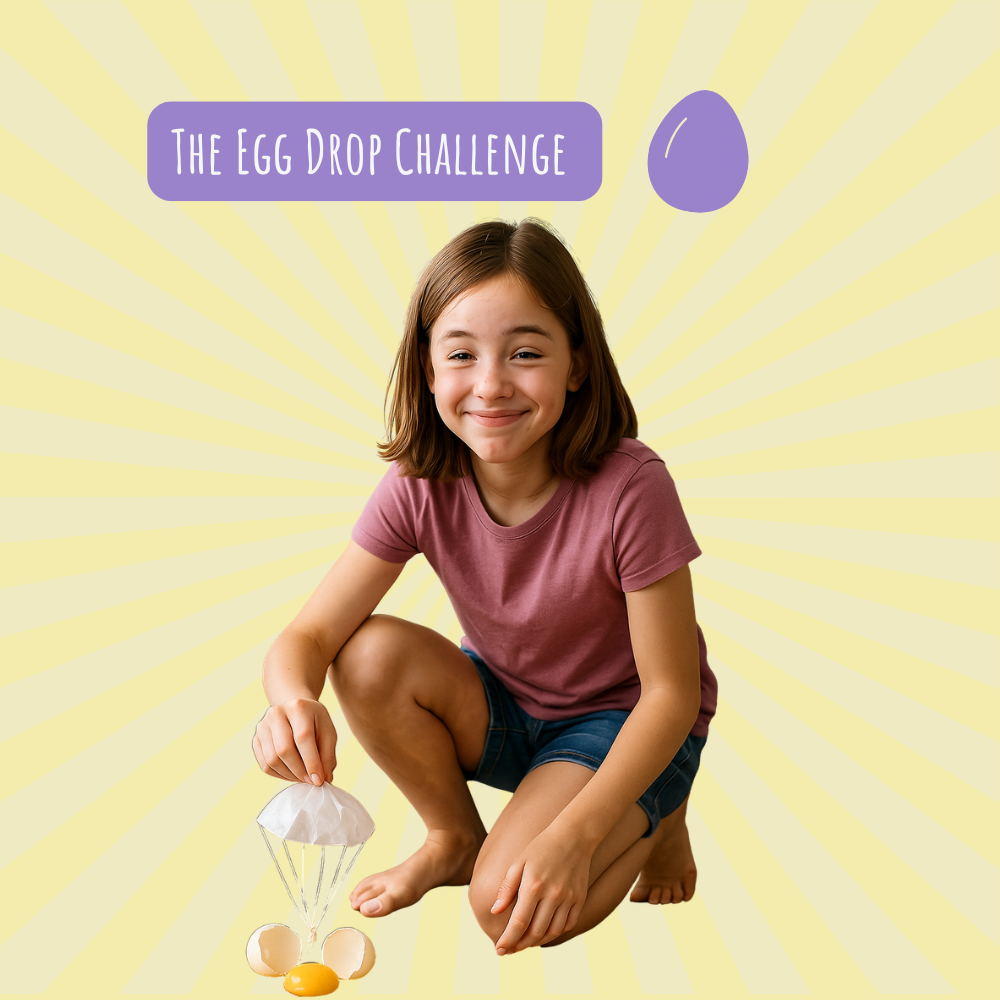
Loads — and most need nothing more than household items. The Newton’s Laws kitchen experiments, the Camera Obscura, and the Egg Drop Challenge are all excellent starting points — hands-on, genuinely fun, and grounded in real physics.
Where can I find more inspiring science content for girls?
The Hey Smart Girl blog has profiles of real women scientists, hands-on experiment guides, and research-based posts for parents on raising curious daughters. You’ll find stories of Mary Anning, Sylvia Earle, Inge Lehmann, Lise Meitner, and Lene Hau. Explore the full blog here.
Are there science books for girls that make physics accessible?
The Hey Smart Girl Book of Physics covers forces, motion, light, sound, electricity, and heat — with over 30 experiments, real women scientist stories woven throughout, and a tone that feels like your coolest aunt explaining the universe. Written for curious girls aged 8–12, available on Amazon.


2 Responses
thanks a lot of information greatfull
Thanks, if you liked that you’ll love the 101 True of False science quiz you can download it here https://heysmartgirl.com/science-quiz-for-kids-free-printable/