
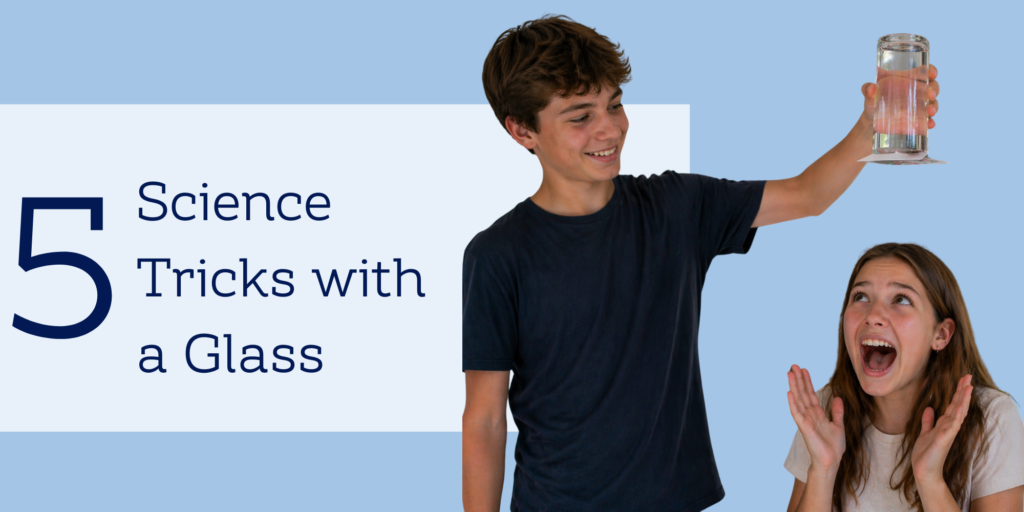
No special equipment. No mess. Just a glass, a few household bits, and five moments of genuine wonder.
You know those slow afternoons when you need something to do that isn’t a screen? This is it. Grab a glass from the kitchen cupboard — that’s genuinely all you need to get started — and prepare to completely blow your child’s mind.
These five tricks take moments to set up and seconds to perform. The science behind them is real, fascinating, and genuinely impressive. And fair warning: they will want you to do every single one of them again. And again. And possibly again after that. Which is, honestly, exactly the point.
Trick 1
The Coin That Drops Into the Glass
The science: Inertia — Newton’s First Law of MotionThe trick
Place the card flat over the top of the glass. Balance the coin on the centre of the card. Now flick the card sharply from the side with your finger — as fast and as horizontally as you can. The card flies away. The coin drops straight down into the glass.
Why it works
The coin has no reason to move sideways, so it doesn’t. It simply falls straight down under gravity into the glass below — a perfect demonstration of inertia, the tendency of an object to stay exactly where it is unless a force acts on it directly.
Inertia is the reason seatbelts exist — and the reason astronauts in space keep floating in the same direction unless something stops them.
Trick 2
The Upside-Down Glass of Water
The science: Atmospheric PressureThe trick
Fill the glass completely to the brim — this is important. Any air gap inside the glass will equalise the pressure and the trick fails. Press the card firmly and flatly against the rim. Turn the glass upside down over a sink — and slowly remove your hand from the card. It stays. The water stays. Nothing falls.
Why it works
The air outside the glass is pressing up on the card with more force than the water inside is pressing down. We live at the bottom of a vast ocean of air and we never feel it — until a moment like this makes it impossible to ignore.
Trick 3
The Glass That Makes Things Bigger
The science: Refraction — how light bendsThe trick
Fill the glass most of the way up with water. Hold a piece of paper with text or a small drawing behind the glass and look through it. Move the paper slowly further away from the glass. Watch what happens to the image as you move it back.
Why it works
The curved glass filled with water acts as a lens. Light bends as it passes from air into water and back out again. When the paper is close, the image can appear bigger — this is magnification. When the paper is far enough away, the light rays cross over and the image flips from left to right. Your glass has just become an optical instrument.
This is the same principle behind camera lenses, eyeglasses, microscopes, and telescopes. Every time your child puts on a friend’s glasses and the world goes blurry, that’s refraction at work.
Trick 4
The Glass That Makes Music
The science: Resonance and vibrationThe trick
Dip your finger in water to wet it. Press it gently but firmly against the rim of the wine glass and move it slowly in a continuous circle around the rim without lifting it. Keep the pressure steady and the movement smooth. After a few seconds, the glass begins to sing — a clear, sustained, otherworldly tone that seems to come from nowhere.
Why it works
Your damp finger catches and releases against the glass rim hundreds of times per second, causing the glass to vibrate at its own natural resonant frequency. That vibration travels through the air as sound. Add water to change the pitch — more water, lower note.
Opera singers can shatter a wine glass by singing at exactly its resonant frequency with enough power — the same physics, scaled up dramatically.
Trick 5
The Glass That Turns Into a Speaker
The science: Sound amplification and resonanceThe trick
Play music or a video on your phone at its normal volume. Now place the phone — speaker facing down — into the glass. The sound immediately becomes fuller, richer, and noticeably louder. No power, no Bluetooth, no app. Just a glass.
Why it works
The curved walls of the glass collect and reflect the sound waves produced by the phone speaker, bouncing and focusing them upward rather than letting them scatter in all directions. The bigger and more curved the glass, the better the effect — a large wine glass works particularly well.
This is the same principle used in concert hall design — curved surfaces are carefully shaped to direct sound toward the audience rather than letting it disappear into the walls.
Five tricks. One glass. Approximately zero tidying up afterwards.
Your kids will absolutely think you are a science genius after this — and you are welcome to let them believe that for as long as you like. But more importantly, something useful just happened. They spent an afternoon genuinely curious, genuinely surprised, and genuinely engaged with how the world works. That is not a small thing.
Science is not something that lives in laboratories or textbooks. It is in every glass in your kitchen cupboard, waiting for someone to notice. Today, they noticed.
Now go and enjoy the slow afternoon — or what’s left of it after the fourth request to do the upside-down glass trick over someone’s head again.


2 Responses
Thank you! I will definitely try it with my granddaughter during the holidays.
You’re welcome. Have fun with the upside-down glass of water but even if you don’t remove the card it’s still surprising that the water doesn’t spill out. Don’t forget to come back for more simple at home science experiments https://heysmartgirl.com/simple-science-fair-projects/