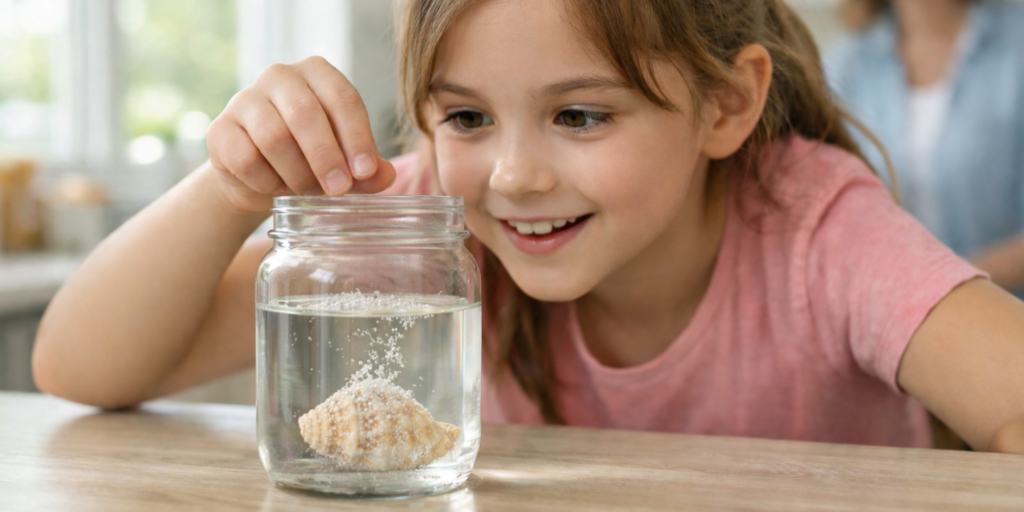
Earth science is one of those subjects that meets kids exactly where they are. They’re already asking the questions. Why is that rock sparkly? Where did this shell come from? Why did the sky go orange last night?
It’s all around them — from the clouds overhead to the ground under their feet — and for girls aged 8 to 12, that natural curiosity lands at exactly the right moment. They’re old enough now to go beyond the surface answer. They can handle the real science, the actual mechanisms behind how things work. And when you show them that? It clicks in a way that sticks.
This experiment is a good example of that. Making a fossil is simple enough to do on the kitchen table on a Saturday afternoon. The science behind it, though, is genuinely mind-bending — and she is absolutely ready for it.
What she’s going to learn
A fossil is the preserved remains — or sometimes just the trace — of a living thing from a very long time ago. We’re talking millions of years. It could be a bone, a shell, a leaf imprint, or even a footprint left in ancient mud that slowly hardened into rock over time.
Here’s the part that will surprise her: becoming a fossil is actually really hard. Most living things die and simply decompose — they rot away and leave nothing behind. For something to become a fossil, a very specific set of things has to happen, and quickly.
The organism needs to be buried fast — usually under layers of sediment like sand, mud, or silt — before scavengers or decay can destroy it. Over time, those layers compact and harden into sedimentary rock. Minerals in the surrounding water gradually replace the original organic material, and what’s left is a rock-hard copy of the original creature.
That process takes thousands to millions of years. Which is exactly why fossils feel like such a big deal when you find one.
She’ll also learn something that surprises most people — fossils are found almost exclusively in sedimentary rock, the kind that forms in layers from sand and mud settling in water. That’s why most fossils come from places that were once underwater: ancient seas, lakes, riverbeds.
It’s also why scientists have found marine fossils — seashells, ancient sea creatures — on the tops of mountains. The rock was once at the bottom of an ancient sea. Earth’s surface has changed that dramatically over millions of years.
Let that one land. It usually does.
The experiment: Make Your Own Fossil
This won’t take millions of years (thankfully). You’re going to make an impression fossil together — the same type that forms when an animal leaves a print in soft sediment that hardens over time.
Think of it as a very fast-forward version of a process that normally takes an almost unimaginable amount of time.
What you’ll need
- Air-drying clay or salt dough (recipe below)
- A small natural object to press — a shell, a leaf with good veins, a piece of bark, or a small bone shape all work well
- Petroleum jelly (Vaseline)
- A rolling pin
- A flat surface
- Optional: plaster of Paris and water, for the next stage
Quick salt dough recipe
Mix 2 cups plain flour, 1 cup salt, and ¾ cup water until you get a smooth, firm dough. Knead it for a couple of minutes.
Done.
What to do
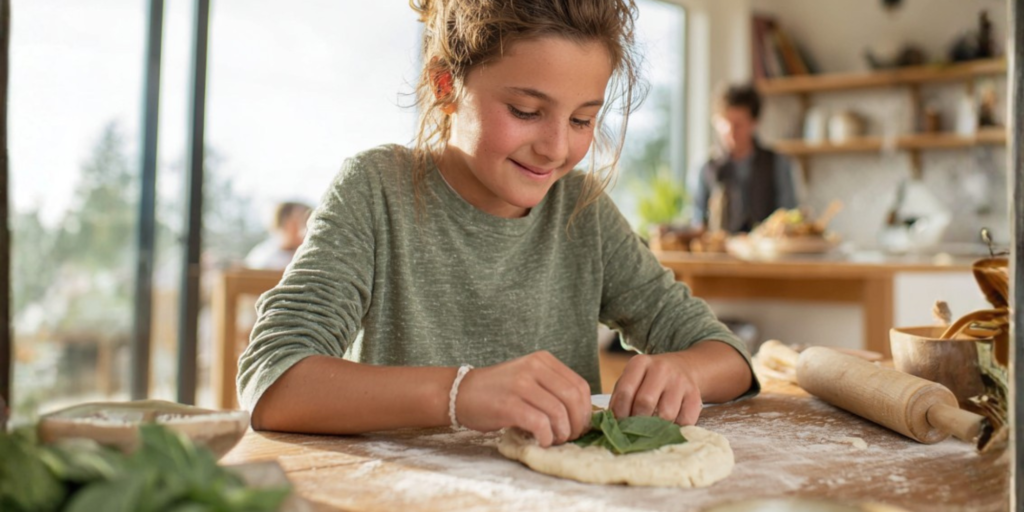
- Roll out the clay or dough: About 2–3 cm thick, flat and smooth on top. Let her do this part — she’ll feel more ownership of the end result.
- Coat the object lightly in petroleum jelly: This stops it sticking when you pull it out, just like a palaeontologist separating a fossil from surrounding rock. That’s a good thing to mention while you’re doing it.
- Press the object firmly into the clay: Straight down, even pressure, then straight back up. No twisting. What’s left is the impression.
- Remove the object carefully: Lift it straight up and out. The detail left behind is her fossil. Take a good look at it together — the texture, the depth, what transferred and what didn’t.
- Leave it to dry: Air-drying clay takes 24–48 hours. Salt dough can be baked low and slow — around 100°C / 200°F — for 2–3 hours until completely hard.
- Optional — make a cast fossil: Mix plaster of Paris to a thick cream and pour it into the dried impression. Let it set for about 30 minutes, then peel it away. She’s now made a cast fossil — a 3D copy of the original object. This is exactly how many real fossils form, when minerals slowly fill the space left by a decomposed organism.
Keep the questions coming
While you’re working, don’t be afraid to ask questions out loud — even ones you don’t know the answer to. Especially those ones, actually.
How did seashells end up on the tops of mountains? Why do you think we find more fossils near water than anywhere else? Would we know anything about dinosaurs if there weren’t any fossils?
These aren’t trick questions. They’re the kind of thing scientists genuinely puzzled over for years — and if she starts to think out the answers herself she is starting to think like a scientist and developing essential critical thinking skills.
Kudos to you, parent.
Why it matters — beyond the kitchen table
It’s easy to look at this experiment and think: fun afternoon, nice fossil, move on. But the bigger picture is worth pausing on — because when she understands why something matters, that’s when it really sticks.
Fossils are how we know almost everything we know about life on Earth before humans arrived. Without them, the story of our planet — billions of years of it — would simply be missing.
The creatures that existed, how they evolved, when they disappeared, how the continents shifted and the oceans moved — all of that comes from fossils. From an imprint in rock. From something that, against enormous odds, survived.
That’s why scientists dedicate their lives to finding and studying them. Not because it’s abstract or academic, but because every fossil is a piece of evidence that helps us understand where we came from — and, in turn, where we’re going.
Palaeontologists have used fossils to unlock plate tectonics, trace the origins of species, and even understand the history of our climate.
Helping her see that science isn’t a list of facts to memorise but a living, ongoing process of asking questions and following the evidence — that’s the real lesson here.
Scientists are doing that work for all of us, every day. And the best thing we can do is raise girls who understand why it matters.
If you don’t want the fun to end
Once the fossil is fully dry, let her paint it. A wash of earthy browns and ochres — she can make it look as ancient or colourful as she wants.
Then varnish it to seal it.
It’ll sit on her shelf and maybe years from now it might just be the thing that reminds her to stay curious.
Or it might just be a reminder of a nice afternoon she spent with you.
Either way, not bad for a bit of salt dough and a Saturday.