101 True or False Science Questions for Kids (Ages 8–12)
Print these off for the long car journey. Pull them out at dinner when conversation goes quiet. Use them to liven up a slow Tuesday afternoon at home. These 101 true or false science questions cover physics, chemistry, biology, and earth science — and quite a few of them will stump the adults too. Read them out loud, argue about the answers, look things up. That’s the whole point. Answers are revealed under each question. Try not to peek.
⚡ Physics — True or False?
25 questions about light, sound, forces, energy, and the laws that shape our world
-
Question 1
Lightning and thunder happen at the same time.
TRUE
They do happen at the same moment — but light travels so much faster than sound that you always see the flash before you hear the thunder. The further away the storm, the longer the gap. Count the seconds between flash and rumble and divide by three to estimate the distance in kilometres.
-
Question 2
A feather and a hammer dropped from the same height will hit the ground at the same time on the Moon.
TRUE
With no air resistance, gravity pulls all objects at the same rate regardless of weight. Apollo 15 astronaut David Scott proved this live on the Moon in 1971 — he dropped a hammer and a feather together and they landed simultaneously.
-
Question 3
Lightning never strikes the same place twice.
FALSE
Lightning can and does strike the same place multiple times. The Empire State Building gets struck around 20–25 times per year. Tall structures are struck repeatedly because they provide the easiest path to ground.
-
Question 4
Hot water can freeze faster than cold water under certain conditions.
TRUE
This is called the Mpemba effect, named after a Tanzanian student who noticed it while making ice cream in 1963. Scientists still debate exactly why it happens — but it has been observed repeatedly.
-
Question 5
Sound cannot travel through space.
TRUE
Sound needs a medium — air, water, or a solid — to travel through. Space is a vacuum, so there’s nothing for sound waves to move through. Every dramatic explosion in a space film is physically impossible. Real space is completely silent.
-
Question 6
If you leave the fridge door open, the room gets colder.
FALSE
A fridge doesn’t create cold — it moves heat. It pulls heat from inside and releases it at the back. Leave the door open and the motor works harder, pumping even more heat into the room. The room actually gets warmer.
-
Question 7
Glass is a very slow-moving liquid.
FALSE
This is a popular myth. Glass is an amorphous solid. Old windows appear thicker at the bottom because of how they were made in the past — not because the glass has flowed downward over time.
-
Question 8
Humans can hear all sound frequencies.
FALSE
Humans can hear sounds between roughly 20Hz and 20,000Hz. Dogs, bats, and dolphins can all hear frequencies far beyond our range — which is how dolphins can echolocate and bats can navigate in complete darkness.
-
Question 9
A mirror shows a left-right reversed version of your face.
TRUE
When you look in a mirror, your left hand appears on the right side and vice versa. Photos show how others actually see you. This is why people often feel their photos look “wrong” — they’re more used to their mirrored reflection.
-
Question 10
Light from the Sun takes about 8 minutes to reach Earth.
TRUE
The Sun is approximately 150 million kilometres away, and light travels at 300,000 km per second. Do the maths — it’s about 8 minutes and 20 seconds. The warmth you feel in the garden left the Sun while you were still making your breakfast.
-
Question 11
Electricity always travels at the speed of light.
FALSE
The electrical signal travels close to the speed of light, but the actual electrons in a wire move very slowly — sometimes just millimetres per second. It’s like a pipe full of water: turn on the tap and the pressure travels instantly, but the water molecules themselves move slowly.
-
Question 12
A room full of warm air is heavier than a room full of cold air.
FALSE
Warm air is actually lighter than cold air, which is why hot air rises. Hot air balloons work on exactly this principle — heat the air inside and it becomes less dense than the surrounding air, lifting the balloon upward.
-
Question 13
Rainbows are full circles.
TRUE
We usually only see an arc because the ground gets in the way. From an aeroplane — or from the top of a very tall waterfall — you can sometimes see the full circle of a rainbow. The centre of the circle is always directly opposite the Sun from your position.
-
Question 14
You can break the sound barrier.
TRUE
Aircraft and some objects can travel faster than the speed of sound — about 343 metres per second in air at sea level. When they do, they create a sonic boom: a thunderclap caused by the shock wave produced as they pass through the sound barrier.
-
Question 15
Magnets lose their magnetism over time.
TRUE
Magnets can weaken if dropped, heated, or exposed to other magnetic fields. The atoms inside a magnet are aligned in the same direction — disrupt that alignment and the magnet becomes weaker.
-
Question 16
Light travels at the same speed in all materials.
FALSE
Light slows down when passing through denser materials like glass or water — which is what causes refraction (bending). In a vacuum it travels at 300,000 km/s. A scientist called Lene Hau slowed light to just 38 miles per hour using an ultra-cold laboratory experiment.
-
Question 17
Shadows can appear blue in sunlight.
TRUE
In sunlight, shadows are lit by the sky, which is blue. This is most visible in snow scenes where the shadows have a distinctly bluish tint. Painters like Monet noticed this and used blue in their shadows — causing quite a stir at the time.
-
Question 18
You can hear music clearly underwater.
FALSE
Sound travels faster underwater, but our ears aren’t adapted to hear clearly underwater, so music usually sounds muffled and distorted. Marine mammals like dolphins have evolved entirely different hearing systems to process underwater sound effectively.
-
Question 19
Friction always slows things down.
FALSE
Without friction you couldn’t walk, grip a pen, drive a car, or pick anything up. Friction enables movement as much as it resists it. Ice is so slippery precisely because friction is reduced — your feet can’t grip the surface to push off.
-
Question 20
Electricity can be generated from movement.
TRUE
This is how generators work — moving a magnet near a coil of wire creates an electrical current. Every power station on Earth works on this principle: wind, water, or steam spins a turbine, the turbine moves a magnet, and electricity flows.
-
Question 21
You weigh slightly less at the equator than at the poles.
TRUE
The Earth bulges at the equator, putting you further from the centre of the Earth and slightly reducing the gravitational pull. The difference is small — about 0.5% — but it’s real and measurable.
-
Question 22
Static electricity can be generated by combing your hair.
TRUE
Combing transfers electrons between materials, building up a static charge on the comb. Hold it near small pieces of paper or your hair after combing and you’ll see the effect. The same physics is behind lightning — just on a much, much larger scale.
-
Question 23
Sound waves and light waves are the same type of wave.
FALSE
Sound is a mechanical wave that needs a medium to travel through. Light is an electromagnetic wave that can travel through a vacuum. They behave very differently — which is why you can see lightning before you hear thunder, and why there’s no sound in space.
-
Question 24
All colours of light travel at the same speed in a vacuum.
TRUE
In a vacuum, all wavelengths of light travel at exactly the same speed. They only separate — revealing the colours of the rainbow — when passing through a prism or water droplets, which slow down different wavelengths by different amounts.
-
Question 25
Metal feels colder than wood because it is colder.
FALSE
Pick up a metal spoon and a wooden spoon that have been sitting in the same room. Both are exactly the same temperature — but metal feels colder because it conducts heat away from your hand much faster than wood does. It’s not the temperature that’s different. It’s the material.
🧪 Chemistry — True or False?
25 questions about atoms, reactions, materials, and the science hiding in your kitchen
-
Question 26
Diamonds and pencil lead are made of the same element.
TRUE
Both are made entirely of carbon. The difference is how the atoms are arranged — diamonds have a rigid crystal lattice that makes them incredibly hard, while graphite (pencil lead) has layers that slide easily. Same element, completely different structure, completely different properties.
-
Question 27
Water is the only substance that expands when it freezes.
FALSE
Several substances expand when frozen, including bismuth and gallium. But water is the most important example — ice is less dense than liquid water, which is why ice floats. If ice sank, lakes would freeze solid from the bottom up, killing everything in them.
-
Question 28
All acids are dangerous.
FALSE
Vinegar, lemon juice, and cola are all mildly acidic and completely safe to eat and drink. Your stomach contains hydrochloric acid to help digest food. Acids exist on a scale — only strong acids at high concentrations are dangerous.
-
Question 29
Rust is a completely new substance — not just iron going bad.
TRUE
Rust (iron oxide) is a completely different chemical compound from iron. It forms when iron reacts with oxygen and water — a chemical change, not just a physical one. Iron turns into something new. That’s why you can’t simply scrape off the rust and get the original iron back.
-
Question 30
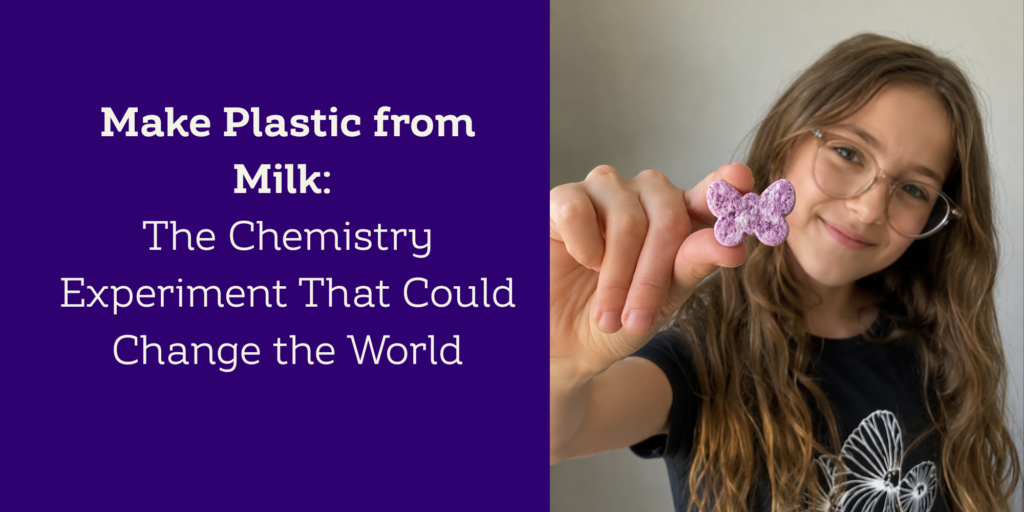
You can make plastic from milk.
TRUE
The protein in milk (casein) can be extracted with vinegar and moulded into a basic natural polymer. This was used commercially before petroleum-based plastics were invented — and scientists are now revisiting plant-based plastics as a sustainable alternative.
-
Question 31
The periodic table was invented by a woman.
FALSE
The modern periodic table was developed by Dmitri Mendeleev in 1869. However, many women made enormous contributions to our understanding of the elements — Marie Curie discovered two of them: polonium and radium.
-
Question 32
Baking soda and baking powder are the same thing.
FALSE
Baking soda is pure sodium bicarbonate. Baking powder contains sodium bicarbonate plus a dry acid — so it already has everything it needs to react. Using the wrong one in a recipe can mean flat cakes or very salty biscuits.
-
Question 33
Fire is not a solid, liquid, or ordinary gas.
TRUE
Fire is the visible result of a chemical reaction — combustion — releasing light and heat. It doesn’t fit neatly into any of the three standard states of matter. It’s a dynamic process, not a substance in itself.
-
Question 34
Soap works by destroying bacteria.
FALSE
Soap doesn’t kill bacteria — it lifts dirt, oil, and bacteria off surfaces so they can be rinsed away with water. Soap molecules have one end that attracts water and one end that attracts oil, allowing them to surround and remove oily particles. That’s the science behind washing your hands.
-
Question 35
All metals are solid at room temperature.
FALSE
Mercury is a metal that is liquid at room temperature. Gallium melts in your hand at around 30°C. Both are real metals with shiny surfaces and good electrical conductivity — just not solid at the temperatures we normally encounter.
-
Question 36
Mixing vinegar and bicarbonate of soda creates a completely new substance.
TRUE
When vinegar (an acid) and bicarbonate of soda (a base) mix, they react chemically to produce carbon dioxide gas, water, and sodium acetate. The fizzing you see is the CO₂ escaping. This is a real chemical reaction — the original substances are gone and new ones have formed in their place.
-
Question 37
The fizz in fizzy drinks is oxygen.
FALSE
The bubbles are carbon dioxide (CO₂), dissolved under pressure. When you open a can or bottle, the pressure drops and the CO₂ escapes rapidly as bubbles. The fizz you feel on your tongue is partly the CO₂ reacting with water to form carbonic acid.
-
Question 38
White chocolate melts faster than milk or dark chocolate.
TRUE
White chocolate contains a higher proportion of cocoa butter and melts at a lower temperature — close to body temperature (around 37°C). This is why it feels so creamy and dissolves almost instantly on your tongue. Dark chocolate has a higher melting point and holds its shape longer.
-
Question 39
You can make your own natural dye from plants.
TRUE
Turmeric makes yellow, red cabbage makes purple or blue depending on the pH, and beetroot makes pink. Natural dyeing is one of the oldest forms of chemistry — humans have been using plant pigments to colour fabric for thousands of years.
-
Question 40
Carbon dioxide is heavier than air.
TRUE
CO₂ is denser than air, which is why it sinks and collects at low levels. This is why CO₂ fire extinguishers work — the gas sinks over the fire and smothers the flames by removing the oxygen.
-
Question 41
Gold never rusts or tarnishes.
TRUE
Gold is one of the least reactive metals — it doesn’t oxidise or corrode, which is why it stays shiny for thousands of years. This is also why gold was used for dental fillings and why ancient gold jewellery still looks pristine today.
-
Question 42
Honey never expires.
TRUE
Archaeologists have found edible honey in Egyptian tombs thousands of years old. Its low moisture content and acidic pH prevent bacterial growth indefinitely — as long as water doesn’t get in. Honey is essentially self-preserving.
-
Question 43
Water can be split into hydrogen and oxygen.
TRUE
This is called electrolysis. Running an electrical current through water breaks H₂O molecules into hydrogen gas and oxygen gas. Hydrogen produced this way is being explored as a clean fuel source — the only waste product when it burns is water.
-
Question 44
All elements on the periodic table occur naturally.
FALSE
Elements with atomic numbers above 94 (plutonium) don’t exist naturally on Earth in significant quantities. They are created artificially in nuclear reactors or particle accelerators — and most only last for fractions of a second before they break down.
-
Question 45
The colour of a flame can tell you what’s burning.
TRUE
Different elements produce different coloured flames when heated. Sodium burns yellow, copper burns green, potassium burns violet. This is the principle behind fireworks — the brilliant colours are produced by different metal salts packed into each firework.
-
Question 46
Vinegar is a type of acid.
TRUE
Vinegar contains acetic acid, giving it a pH of around 2–3. It’s weak enough to eat but strong enough to dissolve calcium carbonate — which is why it makes eggshells and seashells fizz, and why it’s used to descale kettles.
-
Question 47
Steam is invisible.
TRUE
What we see above a boiling kettle is actually tiny water droplets that form as steam cools and condenses back into liquid. True steam is an invisible gas — the white cloud appears just after the steam leaves the spout and begins to cool.
-
Question 48
Dry ice is frozen water.
FALSE
Dry ice is solid carbon dioxide (CO₂) at -78.5°C — not frozen water at all. It’s called “dry” because it sublimates directly from solid to gas without becoming liquid, which produces the dramatic foggy effect used in theatre productions and Halloween displays.
-
Question 49
Oil and water don’t mix because oil is lighter.
FALSE
They don’t mix because of molecular polarity. Water molecules are polar (they have positive and negative ends) and oil molecules are non-polar. Like dissolves like — and these two simply don’t attract each other at the molecular level. The density difference is secondary.
-
Question 50
A purple dye was accidentally invented by an 18-year-old trying to make medicine.
TRUE
In 1856, William Perkin was trying to synthesise quinine to treat malaria. His experiment produced a strange purple residue instead. Rather than throwing it away, he tested it — and discovered it was a brilliant, lasting dye. He named it mauveine, made his fortune, and accidentally launched the synthetic dye industry. Science rewards curiosity.
🌿 Biology — True or False?
25 questions about the human body, animals, plants, and the science of living things
-
Question 51
The human body contains trillions of helpful bacteria.
TRUE
Your body is home to trillions of bacterial cells — many of which are essential for digestion, immune function, and general health. The relationship between humans and our microbiome is one of the most exciting areas of current biological research.
-
Question 52
Humans use only 10% of their brain.
FALSE
This is one of the most persistent myths in science. Brain imaging shows that virtually all areas of the brain are active most of the time, even during sleep. Different tasks activate different regions, but the whole brain is in regular use throughout the day.
-
Question 53
Plants breathe in oxygen and breathe out carbon dioxide.
FALSE
During photosynthesis, plants do the opposite — they absorb CO₂ and release oxygen. They do use oxygen during respiration (like animals), but the net effect during daylight is oxygen production. Plants are the reason there’s breathable air on Earth.
-
Question 54
Your heart beats around 100,000 times per day.
TRUE
The average resting heart rate is 60–100 beats per minute, which adds up to roughly 86,000–144,000 beats per day — without you doing anything. Over a lifetime, the heart beats approximately 2.5 billion times. It never takes a day off.
-
Question 55
Humans share a large portion of their DNA with bananas.
TRUE
Around 60% of human genes have a functional equivalent in bananas. We share even more with other primates — about 98.7% with chimpanzees. DNA is the universal instruction manual for life, and many of the most fundamental instructions are shared across very different species.
-
Question 56
Blood is blue inside your body.
FALSE
Blood is always red — even in veins. Veins look bluish through the skin because of the way different wavelengths of light penetrate and reflect off tissue. Deoxygenated blood is a darker red, but it is never blue.
-
Question 57
Your fingernails and hair are made of the same protein.
TRUE
Both are made of keratin — the same protein found in animal hooves, claws, horns, and feathers. Your nails and hair are essentially the same biological material, just growing in different places and different directions.
-
Question 58
The stomach completely replaces its own lining every few days.
TRUE
The stomach lining replaces itself approximately every three to five days because of the harsh acidic environment inside. Without this constant renewal, the stomach would begin to digest itself — which is essentially what happens in a stomach ulcer.
-
Question 59
You can tickle yourself.
FALSE
Your brain predicts the sensory input from your own movements, which cancels out the tickle response. The element of surprise is essential for tickling to work — which is why being tickled by someone else is so much more effective than doing it yourself.
-
Question 60
Humans are the only animals that use tools.
FALSE
Chimpanzees use sticks to extract termites, crows use tools to solve multi-step problems, dolphins use sponges to protect their snouts while foraging, and some birds drop shells from heights to crack them open. Tool use is far more widespread in the animal kingdom than we once thought.
-
Question 61
Your eyes are fully grown at birth.
TRUE
Eyes are almost adult-sized at birth — about 16–17mm in diameter compared to the adult average of 24mm. Unlike most other organs, they don’t grow significantly after you’re born, which is one reason why babies’ eyes look so large relative to their faces.
-
Question 62
Plants can feel pain.
FALSE
Plants respond to damage through chemical signals — releasing compounds to deter insects or alert neighbouring plants. But they have no nervous system, no brain, and no pain receptors. They react to damage without experiencing it.
-
Question 63
The human body gives off tiny amounts of visible light.
TRUE
The body produces tiny amounts of visible light through chemical reactions inside cells. It is far too faint for our eyes to detect — about 1,000 times weaker than anything we can see — but sensitive cameras have captured it. The light is strongest around the face and fluctuates throughout the day.
-
Question 64
Identical twins have identical fingerprints.
FALSE
Identical twins share the same DNA, but fingerprints are influenced by random environmental factors in the womb — like position, movement, and amniotic fluid pressure. They are always slightly different. No two people on Earth have identical fingerprints.
-
Question 65
Your skin is the largest organ in the body.
TRUE
The skin covers approximately 2 square metres in an adult and makes up about 15% of total body weight. It regulates temperature, prevents infection, produces vitamin D, and is packed with sensory receptors. It’s doing a remarkable job of it all at once, right now.
-
Question 66
Sneezing with your eyes open is impossible.
FALSE
It is physically possible, though most people blink reflexively when they sneeze. The myth that your eyes would pop out if you kept them open during a sneeze is completely false — the pressure from a sneeze is not connected to your eye sockets in any meaningful way.
-
Question 67
Sharks need to keep moving to breathe.
FALSE
Most sharks can breathe while stationary by actively pumping water over their gills. However, some species — including the great white shark — do need to keep moving to force water through their gills. It depends on the species.
-
Question 68
Your ears and nose often appear larger as you get older.
TRUE
While cartilage doesn’t continuously grow throughout life, it does change — and skin loses elasticity with age, causing it to sag. The combined effect is that ears and noses often appear larger in older people, even though the underlying growth is not as straightforward as the popular myth suggests.
-
Question 69
Humans have a blind spot in each eye.
TRUE
Where the optic nerve connects to the retina, there are no photoreceptors at all — a genuine gap in your vision. Your brain fills in the missing information using surrounding visual data, which is why you don’t normally notice it. There are simple optical illusions that reveal it.
-
Question 70
Trees can share nutrients and signals through underground fungal networks.
TRUE
Trees are connected through networks of fungi attached to their roots — sometimes called the “wood wide web.” Through these networks, trees can transfer carbon, water, and nutrients. Older trees sometimes support younger seedlings by sending resources through the network.
-
Question 71
Different parts of your tongue taste different things — sweet at the front, bitter at the back.
FALSE
This is a debunked myth based on a misreading of 19th-century research. All taste receptors can detect all five basic tastes — sweet, sour, salty, bitter, and umami — across the whole tongue. The “tongue map” taught in many older textbooks is simply wrong.
-
Question 72
Humans are the only species that cry emotional tears.
TRUE
Other animals produce tears to lubricate and protect their eyes, but humans appear to be the only species that cries in response to emotions. Why we evolved this response is still not entirely understood — it may signal distress to others or release stress hormones.
-
Question 73
The appendix has no function.
FALSE
Once considered completely useless, the appendix is now thought to play a role in gut immunity and may act as a reservoir of beneficial gut bacteria — a safe house that helps repopulate the gut after illness. It’s not essential, but it may not be as pointless as we once thought.
-
Question 74
You lose most body heat through your head.
FALSE
You lose heat through whichever part of your body is uncovered. The head loses no more heat proportionally than any other body part — about 10% of total heat loss. The myth probably comes from cold-weather advice to wear a hat, which makes sense simply because your head is often the only exposed part.
-
Question 75
A strawberry is not botanically a berry.
TRUE
Botanically, a strawberry is an “accessory fruit” — the red flesh develops from the flower’s receptacle, not from the ovary. True botanical berries include bananas, avocados, kiwis, and tomatoes. This is one of those facts that causes genuine disbelief at dinner tables.
🌍 Earth Science — True or False?
26 questions about our planet, its history, oceans, weather, and the forces that shape the world
-
Question 76
The Earth is perfectly round.
FALSE
The Earth is an oblate spheroid — it bulges slightly at the equator and is flattened at the poles due to its rotation. The equatorial diameter is about 43km greater than the polar diameter. From space it looks round, but it isn’t quite.
-
Question 77
We have explored more of Mars’s surface than the bottom of our own ocean.
TRUE
Less than 25% of Earth’s ocean floor has been mapped in high resolution detail. We have detailed maps of Mars’s entire surface. The deep ocean is one of the least explored environments on our own planet — and new species are still being discovered there regularly.
-
Question 78
Earthquakes only happen on land.
FALSE
Most earthquakes actually originate under the ocean along underwater fault lines and tectonic plate boundaries. Underwater earthquakes can trigger tsunamis — enormous waves that travel across entire ocean basins and arrive at coastlines with devastating force.
-
Question 79
Fossils are always made of bone.
FALSE
Fossils can form from shells, teeth, wood, leaves, footprints, skin impressions, and even burrows. The original material is usually replaced by minerals over millions of years — the shape is preserved, but the substance is entirely different.
-
Question 80
The Earth’s core is hotter than the surface of the Sun.
TRUE
The inner core reaches temperatures of around 5,000–6,000°C — comparable to the surface of the Sun. The core is kept solid by the enormous pressure of the planet sitting on top of it, despite the extreme temperature.
-
Question 81
Quicksand will suck you under and swallow you whole.
FALSE
Quicksand is denser than the human body, so you can’t sink below waist depth. It’s more like very thick mud — extremely difficult to escape, but not the deadly trap depicted in films. The danger is more from getting stuck and being unable to escape rising water.
-
Question 82
Seashells on mountain tops prove those mountains were once underwater.
TRUE
Marine fossils have been found high in the Himalayas, proving that those rocks were once on the ocean floor. Tectonic forces pushed the seabed upward over millions of years to form the highest mountains on Earth. The shells went with them.
-
Question 83
Volcanoes only exist on Earth.
FALSE
Volcanoes exist on other planets and moons throughout the solar system. Olympus Mons on Mars is the largest volcano in the solar system — about three times the height of Everest. Jupiter’s moon Io is the most volcanically active body we’ve discovered.
-
Question 84
The North Pole is colder than the South Pole.
FALSE
Antarctica (the South Pole) is significantly colder than the Arctic (the North Pole). Antarctica holds the record for the lowest natural temperature ever recorded on Earth: -89.2°C. The Arctic sits over ocean, which moderates its temperature. Antarctica sits over a continent at high elevation.
-
Question 85
Clouds are made of water vapour.
FALSE
Clouds are made of tiny liquid water droplets or ice crystals — not water vapour, which is an invisible gas. When invisible water vapour rises and cools, it condenses into the tiny droplets that make up clouds. You can’t see water vapour, but you can definitely see clouds.
-
Question 86
The deepest parts of the ocean are colder than the surface.
TRUE
Below the sunlit surface layer, ocean temperatures drop dramatically. The deep ocean sits at around 2–4°C year-round — just above freezing. The enormous pressure and complete darkness of the deep ocean make it one of the most extreme environments on Earth.
-
Question 87
Lightning creates a gas that leaves a smell after a storm.
TRUE
The enormous energy of a lightning bolt splits oxygen molecules, which then recombine to form ozone — a gas with a sharp, clean smell. That distinctive smell after a thunderstorm is partly ozone. Lightning also produces nitrogen oxides, which contribute to the post-storm scent.
-
Question 88
Mount Everest is the tallest mountain on Earth.
FALSE
Everest is the highest point above sea level at 8,849m. But Mauna Kea in Hawaii is taller from base to summit — most of it is just underwater. And if measured from the centre of the Earth, Chimborazo in Ecuador actually wins because of the Earth’s equatorial bulge.
-
Question 89
Tectonic plates move at roughly the same speed as your fingernails grow.
TRUE
Plates typically move 2–10 centimetres per year — roughly the same rate as human fingernail growth. It sounds slow, but over millions of years this movement has completely rearranged the continents, built mountain ranges, and opened and closed entire oceans.
-
Question 90
There is a sea so salty it’s nearly impossible to sink in.
TRUE
The Dead Sea has a salt concentration of around 34%, compared to 3.5% in regular seawater. The density is high enough that the human body floats on the surface without any effort at all. You can sit in it and read a book — which people actually do.
-
Question 91
Deserts are always hot.
FALSE
A desert is defined by low precipitation — less than 250mm of rain per year — not by temperature. Antarctica is technically the world’s largest desert, receiving almost no precipitation. Cold deserts also exist in central Asia and the Arctic.
-
Question 92
Rivers always flow south.
FALSE
Rivers flow downhill — in whatever direction that happens to be. The Nile flows northward. The River Thames flows generally eastward. Direction depends entirely on the landscape, not on compass bearing.
-
Question 93
Stalactites grow down, stalagmites grow up.
TRUE
An easy way to remember: stalacTITES hold TIGHT to the ceiling. StalagMITES MIGHT one day reach the ceiling. Both form from mineral-rich water dripping through limestone caves over thousands of years.
-
Question 94
The ozone layer is above the clouds.
TRUE
The ozone layer sits in the stratosphere, roughly 15–35 kilometres above the Earth’s surface — well above where weather and clouds occur. It absorbs most of the Sun’s harmful ultraviolet radiation, acting as a protective shield for life on Earth.
-
Question 95
Soil is just crushed rock.
FALSE
Soil is a complex mixture of minerals, organic matter, water, air, and billions of living organisms including bacteria, fungi, worms, and insects. A single teaspoon of healthy soil can contain more microorganisms than there are people on Earth.
-
Question 96
The ocean absorbs carbon dioxide from the atmosphere.
TRUE
The ocean absorbs roughly 25–30% of all CO₂ produced by human activity. This is slowing climate change but causing ocean acidification — making the water more acidic, which harms coral reefs and shellfish. The ocean is protecting us, but it’s paying a price.
-
Question 97
An earthquake in one place can trigger earthquakes elsewhere.
TRUE
Large earthquakes can stress fault lines elsewhere and sometimes trigger further seismic activity in different locations. Predicting exactly when and where these secondary events might occur is still one of the great challenges in seismology.
-
Question 98
Sand dunes can make sounds.
TRUE
Some sand dunes produce a deep humming or booming sound when disturbed — caused by layers of dry sand grains vibrating together. It can be loud enough to hear from several kilometres away. Marco Polo wrote about the phenomenon in the 13th century.
-
Question 99
The continents were once one giant landmass.
TRUE
About 300 million years ago all the continents were joined in a supercontinent called Pangaea. They’ve been slowly drifting apart ever since — and they’ll continue to move. In about 250 million years, the continents may come together again to form a new supercontinent.
-
Question 100
The Amazon rainforest produces most of the world’s oxygen.
FALSE
The Amazon produces enormous amounts of oxygen, but it also consumes roughly as much through decomposition. The net contribution to global oxygen is much smaller than often claimed. The majority of Earth’s oxygen actually comes from phytoplankton in the ocean.
-
Question 101
A female scientist discovered the Earth has a solid inner core just by studying wave data — without ever going underground.
TRUE
In 1936, Danish seismologist Inge Lehmann published a paper proposing that the Earth has a solid inner core surrounded by a liquid outer core — deduced entirely from analysing seismic wave patterns on paper. Scientists ignored her for 15 years. She was right all along. No probe has ever reached the inner core. Nobody has ever been there. She figured it out from her desk.
Ready for the full series?
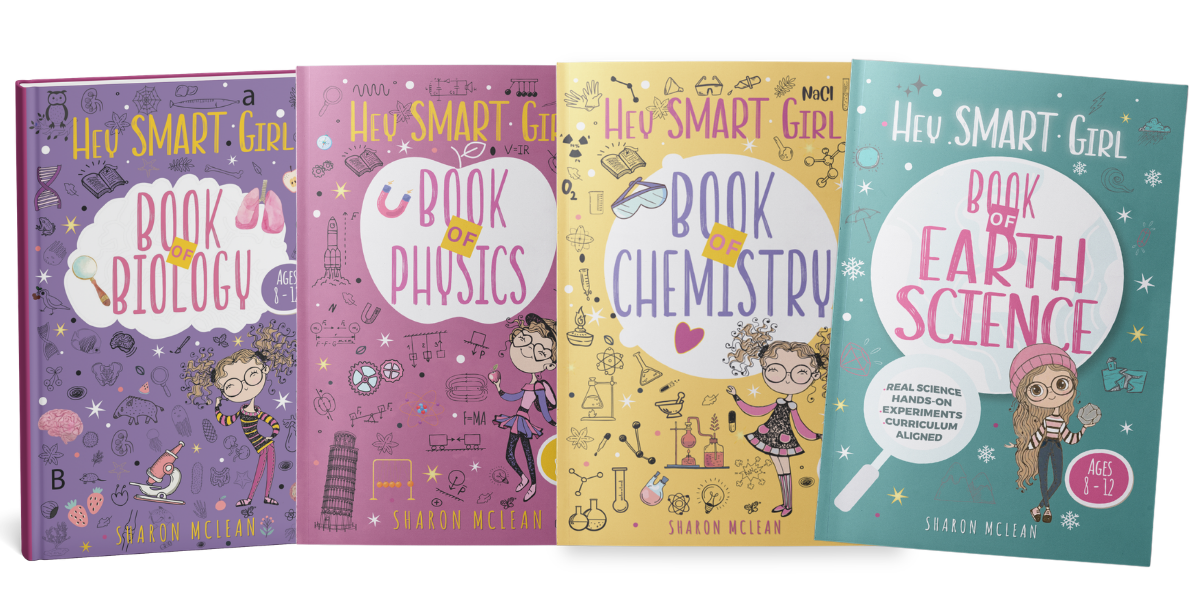
The Hey Smart Girl science book series covers physics, chemistry, biology, and earth science through 30+ hands-on experiments per book, inspiring women scientist stories, and curriculum-aligned explanations written for curious girls aged 8–12. All four titles available on Amazon.
Find the books on Amazon →FAQs
Is it important for girls to learn science?
Absolutely — and not just because of career opportunities, though those matter too. Science teaches girls to ask questions, test ideas, handle failure as part of the process, and think independently. These are confidence-building skills that carry into every area of life. Research consistently shows that girls who engage with science early develop stronger problem-solving skills and greater self-belief. For more on this, read our post on the benefits of STEM for girls.
How can I get my daughter interested in science?
The most effective approach is to treat science as normal conversation rather than a formal subject. Share a surprising fact at dinner. Try a kitchen experiment together. Show her stories of real women scientists who changed the world. Don’t worry about having all the answers — curiosity is more contagious than knowledge. The Hey Smart Girl blog has dozens of ideas to get started.
What are the benefits of science for girls?
Beyond the obvious academic benefits, science builds resilience (experiments fail — and that’s the point), critical thinking, creativity, and genuine confidence. Girls who see science as something that belongs to them are more likely to pursue it — and to bring that problem-solving mindset to whatever they choose to do. The research-backed benefits of STEM for girls are worth reading if you want the fuller picture.
Where can I find more science resources for kids ages 8–12?
The Hey Smart Girl blog is packed with hands-on experiment guides, inspiring women scientist stories, science fact posts, and advice for parents raising curious daughters. New content is added regularly — it’s worth bookmarking. You’ll find chemistry, physics, biology, and earth science content all in one place, written specifically for girls aged 8–12 and the adults who want to support them.