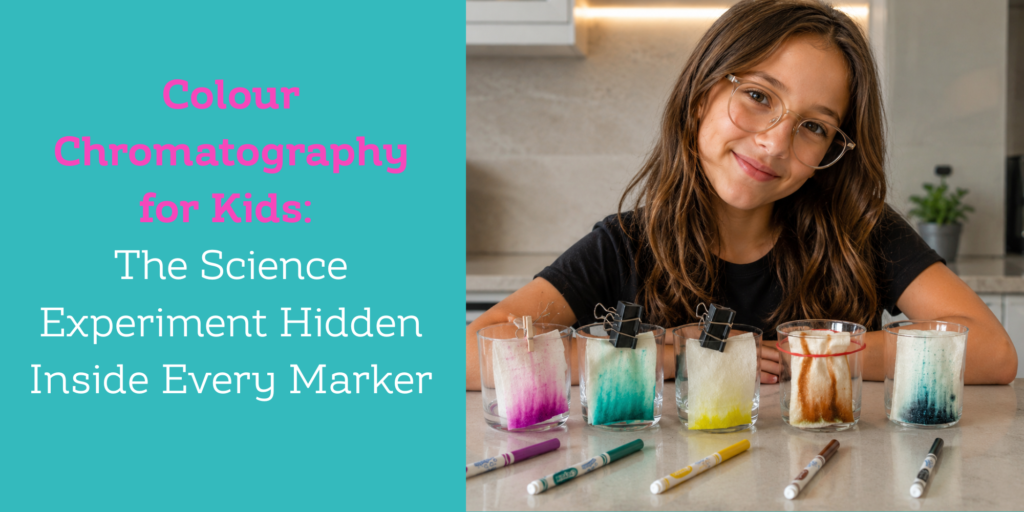
I genuinely wish I had a proper camera tripod or grip set up for this one because a time lapse would have been spectacular. Watching the colours spread up the paper in real time is one of those moments where you find yourself just standing there, marker in hand, completely forgetting what you were supposed to be doing next.
This is chromatography — and it is one of those experiments where the science story is as good as the visual. Which, given how spectacular the visual is, is saying something.
A quick note before we start — this experiment is usually done with coffee filters, and there’s a good reason for that. Coffee filters are made from a fine, consistent paper that absorbs water at exactly the right speed for clean separation. I couldn’t find any in Milan — Italians are not big filter coffee people it turns out — so I had to improvise. I tried copy paper (too smooth, water wouldn’t travel), kitchen roll (too thick and fast, the colours just flooded), and eventually landed on a thick paper napkin — specifically one from a dumpling takeaway, because I throw nothing out. It worked beautifully. So if you don’t have coffee filters, a good quality thick paper napkin is your best alternative and I’ve done the testing so you don’t have to.
What Is Chromatography?
Chromatography is a way of separating mixtures by how fast their components travel through a material.
The ink in a washable marker isn’t one single dye — it’s a mixture of several different dyes blended together to create the colour you see. When water travels up through the paper it carries those dye molecules with it, but different dyes travel at different speeds depending on how strongly they’re attracted to the paper fibres. The faster-moving dyes travel further up the strip. The slower ones stay lower down. Over a few minutes those dyes separate out into distinct bands of colour — and suddenly you can see exactly what was hiding inside your marker all along.
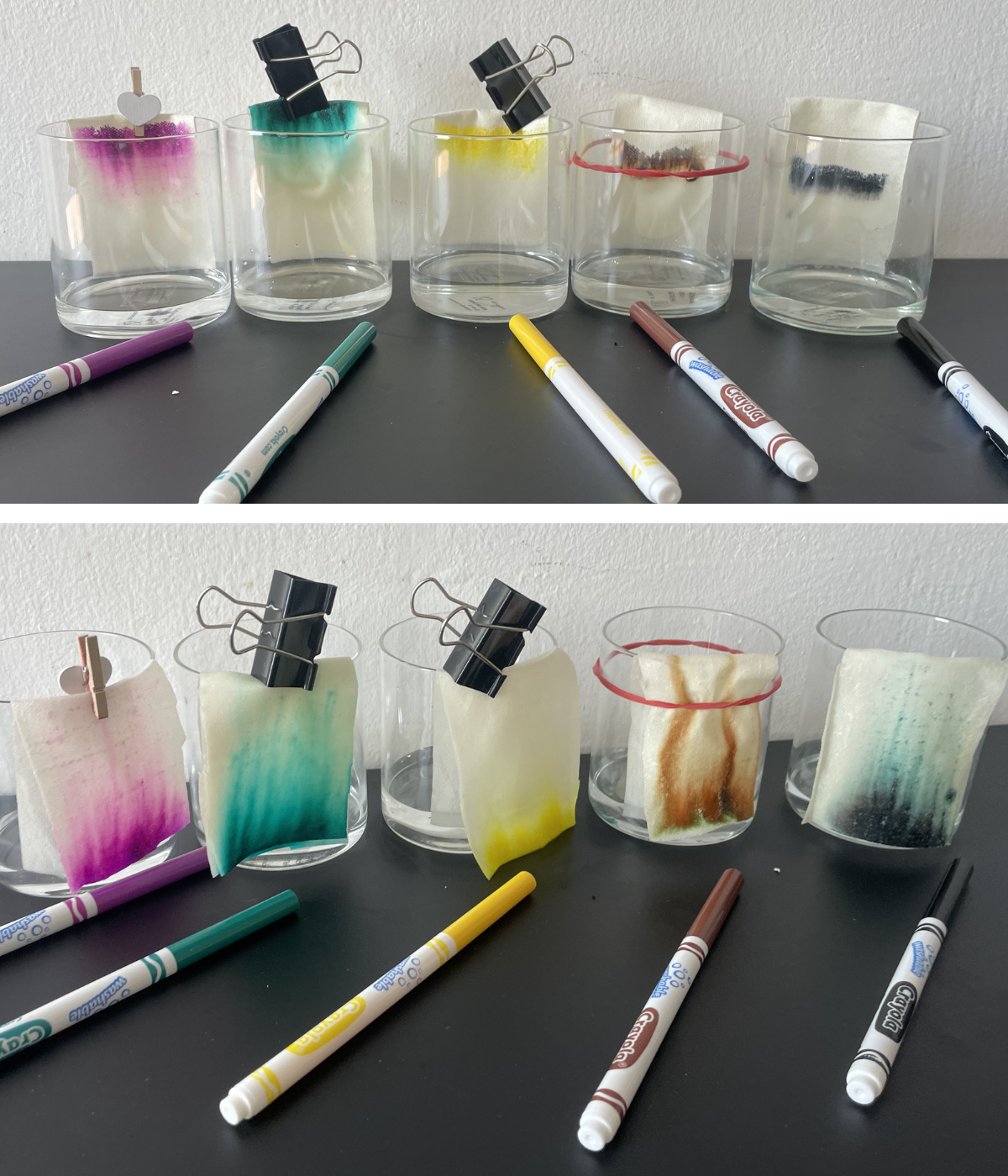
The result can be genuinely jaw-dropping. Brown marker containing green. Black marker containing dark blue. Purple separating into a completely unexpected magenta and violet. Colours that were invisible until water pulled them apart.
Real scientists use industrial versions of exactly this process every day — to check that medicines are pure, to identify unknown substances in forensic labs, and to match ink from documents in criminal investigations. The same principle your daughter is about to use on a napkin is used to catch forgers. Tell her that before she starts.
What You Need
- Washable markers — Crayola washable markers work brilliantly. Different brands will give you different results so if you have more than one brand it’s worth testing both
- Coffee filters — these work best. If you don’t have any, a good quality thick paper napkin is an excellent substitute
- A glass of water for each colour you’re testing — just a small amount in the bottom, about 1cm deep
- Binder clips, pegs, or a rubber band to hold the strips in place over the glass
- Scissors to cut your strips
How To Do It
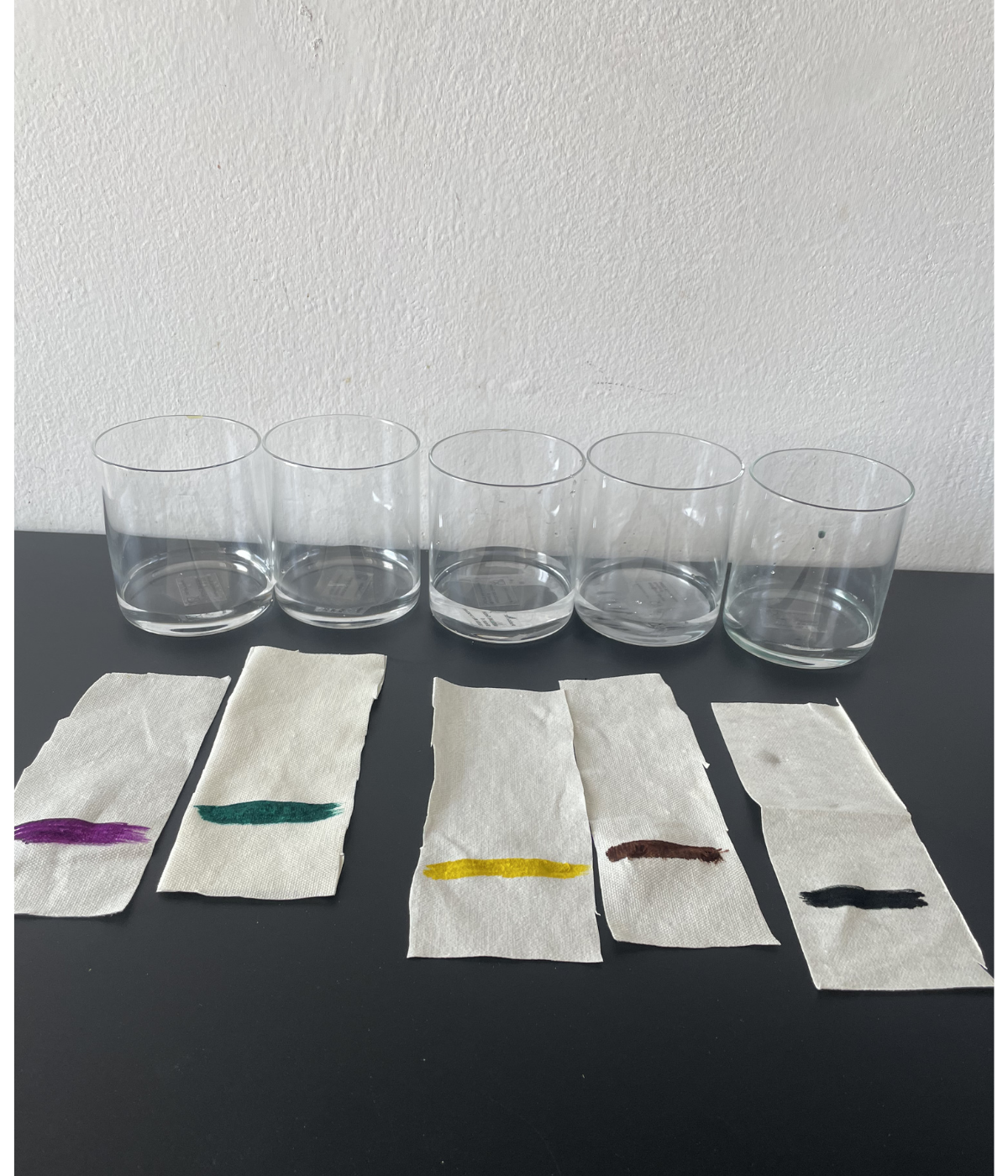
- Cut your paper or coffee filter into strips roughly 3cm wide and tall enough to hang over the glass with the bottom just touching the water.
- Draw a thick line across each strip about 2cm from the bottom — one colour per strip. A thick line works better than a dot on absorbent paper as it gives more pigment to separate.
- Hang each strip over a glass with just the very bottom tip touching the water — the ink line should be above the waterline.
- Clip or peg the strip to the glass to hold it in place, or simply rest it against the inside of the glass.
- Now — and this is important — don’t walk away. The results can happen very quickly and you do not want to miss the moment the colours start to spread. Stay and watch. It’s worth it.
- After 5-10 minutes the water will have travelled up the strip carrying the ink with it. Remove the strips and lay them flat to dry.
Best colours to test: Purple, green, brown and black give the most dramatic results. Yellow is interesting precisely because nothing happens — it’s a single pigment dye and travels as one intact band with no separation. Start with black or purple for the most impressive first result.
What Happened and Why
Here’s what I found with each colour — and a couple of these genuinely surprised me:
Purple gave the most beautiful result — a striking separation into deep magenta at the bottom and violet higher up. Visually the most dramatic.
Green (teal) was the most stunning to watch — it separated into a rich blue at the bottom and bright yellow higher up, showing clearly that green is made from blue and yellow dyes blended together.
Yellow did something different — and this is actually the most interesting result scientifically. The original line completely disappeared from where I’d placed it and a solid yellow band appeared at the top of the strip. No separation, no hidden colours — just yellow. That’s because yellow is a single pigment dye. There’s nothing to separate. It simply travels as one intact band. The control result that makes every other colour more impressive by comparison.
Brown was my favourite surprise. I expected warm oranges and tans. What I got included shades of green — actual green, hiding inside a brown marker. Brown ink containing green dye is genuinely not what you expect and it produces the most interesting and complex result of the five.
Black separated into shades of dark blue — distinct bands showing the different blue dyes blended together to make black.
This Isn’t Just a Fun Experiment — It’s Real Science
Here’s something worth saying out loud before you pack away the napkins and markers. What your daughter just did is not a party trick. It’s not a rainy afternoon activity to keep kids busy. It is a real scientific technique used in laboratories every single day.
The chromatography she just watched on a kitchen napkin is the same principle used by pharmaceutical companies to check that medicines contain exactly what they’re supposed to — and nothing they shouldn’t. It’s used by forensic scientists to identify unknown substances at crime scenes. It’s used by food scientists to check that what’s in your food matches what’s on the label. It’s woven into the fabric of medicine, food safety, technology, and environmental science. Every time you take a tablet, eat packaged food, or use a product that’s been tested for safety, chromatography was almost certainly involved somewhere along the way.
Science isn’t just a school subject. It’s the reason medicine works, the reason technology exists, and the reason so many of the things we take for granted in everyday life are safe and reliable. And the world needs more people who understand it, who are curious about it, and who are willing to ask the questions that lead to the next breakthrough. I am on a mission to show girls just how important — and how genuinely fun — science is. Because science needs girls exactly like yours to make the next big discovery.
Already Read the Book of Chemistry?
If your girl has already worked her way through Hey Smart Girl: Book of Chemistry she’ll already have a head start — she’ll know a thing or two about how chemistry works and why it matters. This experiment is chemistry in action, live on your kitchen table.
Tips Before You Start
- Washable markers only — permanent markers won’t work because the dyes are fixed and don’t travel with water
- Draw a thick line rather than a dot — more pigment means better separation on absorbent paper
- Stay and watch — results can happen within 2-3 minutes and the moment the colours start spreading is the best part
- Test multiple colours at the same time so you can compare results side by side — seeing all five together is much more impressive than one at a time
- Different marker brands give different results — if you want to extend the experiment try the same colour in two different brands and see what happens
- Leave the strips to dry flat after the experiment — they make beautiful bookmarks or decorations and are worth keeping
More hands-on chemistry for curious girls
Pick one and do it this week — your future scientist will thank you.
How did yours go? Drop a comment below or tag me on Pinterest @HeySmartGirl — and if brown gave you the green surprise too, I’d love to know.
Frequently Asked Questions
What is chromatography for kids?
Chromatography is a way of separating mixtures by how fast their components travel through a material. In this experiment water travels up a strip of paper carrying ink dyes with it, but different dyes travel at different speeds and separate into distinct colour bands — revealing the hidden colours inside every marker.
What markers work best for chromatography?
Washable markers work best — Crayola washable markers are widely recommended and give great results. Permanent markers won’t work because the dyes are fixed and don’t travel with water. The best colours to try are purple, green, brown and black as these contain the most complex dye mixtures and give the most dramatic separation.
Do you need coffee filters for chromatography?
Coffee filters work well because they’re made from a fine, consistent paper that absorbs water at the right speed. However a good quality thick paper napkin works as an excellent substitute if you don’t have coffee filters. Avoid copy paper (too smooth) and thin kitchen roll (absorbs too fast).
Why does black marker separate into different colours?
Black ink isn’t a single dye — it’s a mixture of several different coloured dyes blended together to create black. When water carries these dyes up the paper each one travels at a different speed depending on how strongly it’s attracted to the paper fibres. The dyes separate into distinct bands revealing the hidden colours — usually blues, purples and sometimes greens — that were mixed together all along.
Is chromatography used in real science?
Yes — chromatography is one of the most widely used techniques in professional science. Pharmaceutical companies use it to check that medicines contain exactly what they’re supposed to. Forensic scientists use it to identify unknown substances at crime scenes. Food scientists use it to verify that food labels are accurate. The same principle used in this kitchen experiment is used in laboratories every single day.