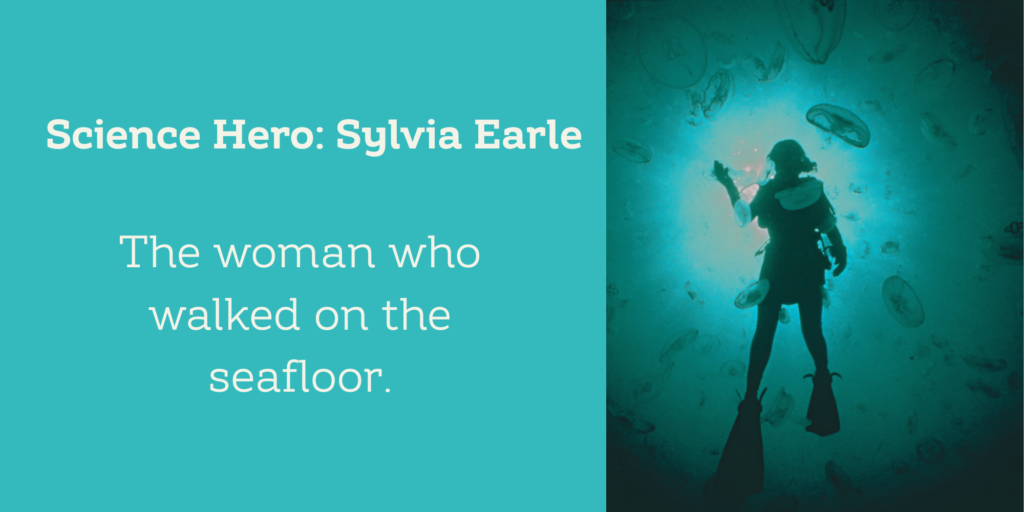
In 1979, a woman walked along the seafloor 400 metres below the surface — deeper than any human had ever walked before. It was near-total darkness. The pressure outside her suit was crushing. Around her, creatures glowed in the black water.
She described it as walking through a galaxy underwater.
Her name is Sylvia Earle. TIME magazine called her a Hero of the Planet. The scientific world calls her Her Deepness — possibly the greatest nickname ever given to a scientist.
She has spent more time underwater than almost any other human being on Earth, led over a hundred ocean expeditions, discovered new species, and dedicated her life to protecting an ocean most of us take completely for granted.
And it all started with a wave knocking her off her feet as a little girl — and her grinning.
Want the printable story card?
The story
Sylvia Earle grew up in New Jersey in the 1940s, and from the time she could walk she was drawn to the natural world — tide pools, ponds, the living things she found in both.
When her family moved to Florida’s Gulf Coast, the ocean took over.
She learned to scuba dive in the 1950s, at a time when very few women were doing anything of the sort, and she never really surfaced.
In 1970, she led a team of female aquanauts — scientists who lived and worked underwater for two weeks in a research station on the seafloor.
They conducted experiments, collected samples, and proved that sustained underwater science was possible.
Then came 1979.
Wearing a pressurised suit called a JIM suit, Sylvia was lowered to the seafloor off the coast of Hawaii. For over two hours, she walked alone in the deep ocean — no tether, no safety line, just herself and the darkness.
It remains one of the deepest untethered dives ever made.
She went on to become the first female Chief Scientist of NOAA and founded Mission Blue — a global effort to protect ocean ecosystems.
She recently turned 90. She is still diving.
The science — what did she discover?
Sylvia’s work helped scientists understand marine ecosystems — from tiny plants to massive ocean systems.
She studied how pollution, overfishing, and climate change affect life in the ocean.
But perhaps most importantly, she helped the world realise how little we actually know.
Less than 10% of the ocean has been explored.
The ocean produces over half the oxygen we breathe, regulates our climate, and supports life on Earth.
Her message is simple:
“No water, no life. No blue, no green.”
Want to make this idea real?
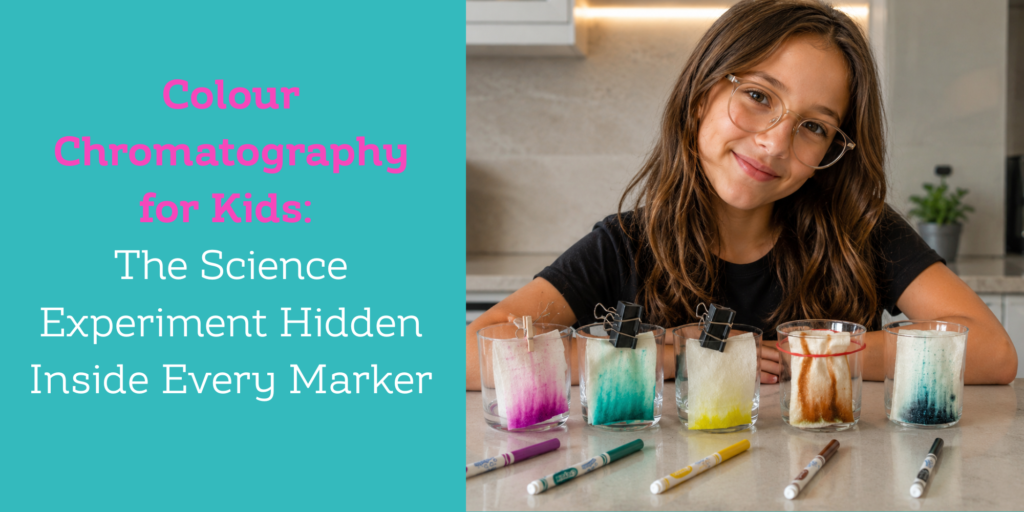
The ocean acidification experiment shows what Sylvia’s work looks like in real life — right in your kitchen.
It’s a simple hands-on experiment that helps kids see how carbon dioxide changes ocean chemistry.

Why it matters today
The problems Sylvia has spent her life studying are happening right now.
Coral reefs are bleaching. Ocean temperatures are rising. Plastic pollution has reached even the deepest parts of the sea.
But the ocean is also resilient.
When protected, ecosystems can recover — sometimes faster than expected.
That’s why Sylvia focuses on solutions as much as problems.
What your daughter can take from this story
- Curiosity is the starting point. A wave knocked her over — and she smiled.
- She did things no one had done before. Sometimes you are the first.
- Science leads to action. Understanding something makes you want to protect it.
- The world is still full of unknowns. The biggest discoveries haven’t been made yet.
Let her read it herself
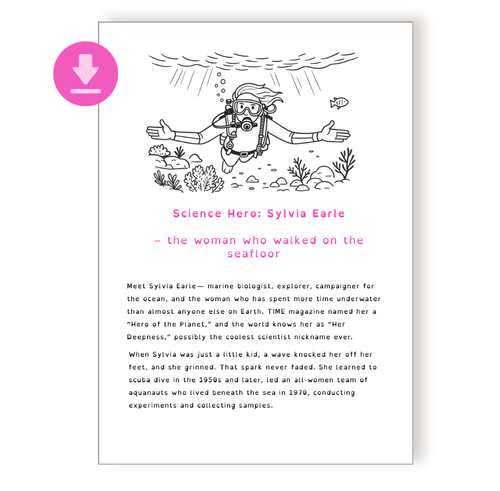
Download the printable version of Sylvia’s story — written just for girls.
More hands-on science for curious girls
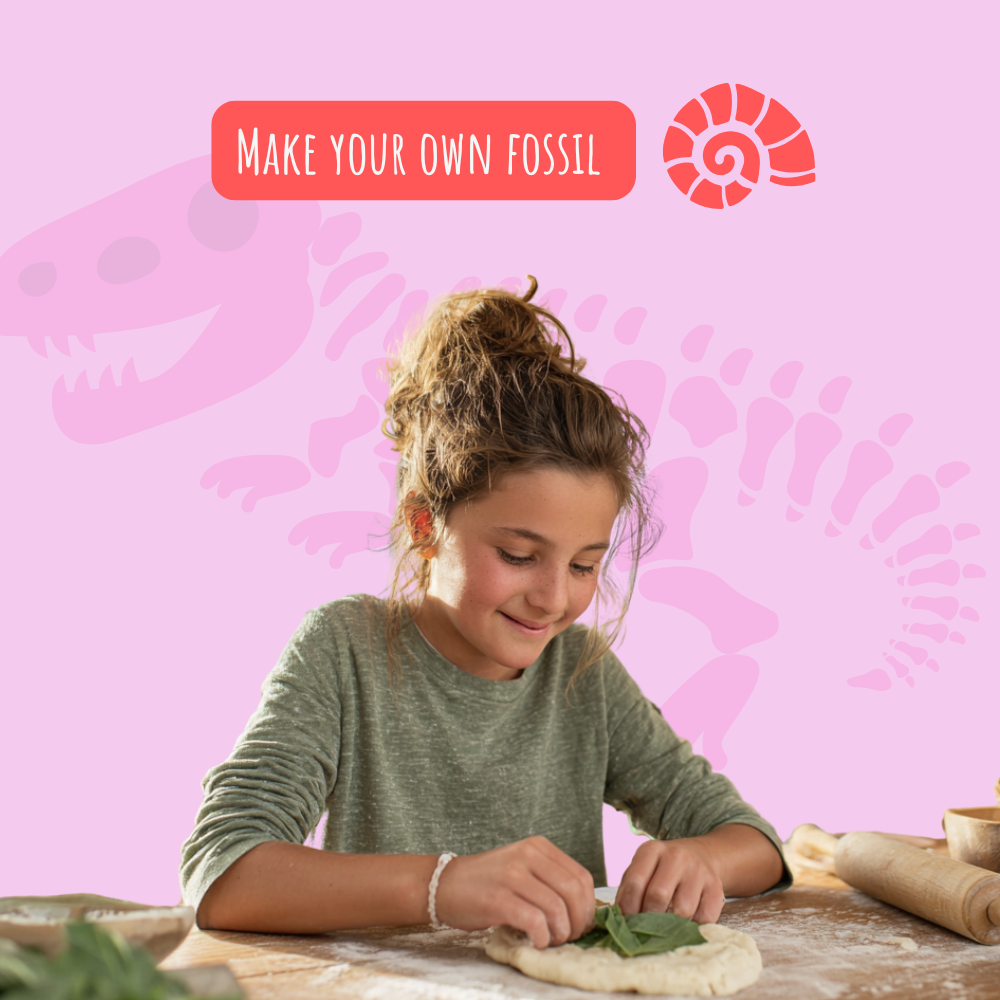
Pick one and do it this week — your future scientist will thank you.


Loved this topic?
The Hey Smart Girl Book of Earth Science explores fossils, oceans, weather, earthquakes, climate, and the brilliant scientists who changed how we understand our planet.
Explore the Earth Science Book